rss

Modular Diary – 085

Robert Syrett suggested making some Halloween patches on the Audulus forum and I’d hoped to make a little patch with some typical ghostly sweeps based on Rob Hordijk’s fluctuation modulation. I unfortunately didn’t find the time, but did manage a quick µFluct module.

STS on the other hand has built a full-blown Halloween soundscape around his newly created Harmonium and µTuring modules.

Modular Diary – 080

A little side note on octaves. I noticed at the end of Hordijk’s Rungler Demo at Modular Meets Leeds (at around 14min) that he actually has the Rungler (stepped) out set to cover a range of 9 octaves. I also noticed in a post of his on the electro-music forum that the Benjolin oscillators cover a range of 18 octaves! And that led to a discussion with stschoen on the Audulus forum, who explained the reasoning behind setting the oscillators in his Audulus Rungler to cover a range of 14 octaves:

As far as the oscillator range is concerned, I realized this morning that when I mentioned 14 octaves for my copy, I had taken 2Hz as the lower bound. The real bottom limit for the oscillators is 0.001 Hz, so the actual range is approximately 25 octaves, although I’m not sure that this has much meaning when applied to something running at sub-audio rates. I choose 2^14 as the upper limit for the oscillators since that’s slightly above 16K and that seemed high enough. 2^15 would have been 32K which is well above the Nyquist limit and so couldn’t be produced in any case at a 44.1k sample rate.

There was also further discussion on whether the rungler output should be set as a bipolar audio signal or a (standard) unipolar control signal, with STS eventually deciding to leave it as the latter since it could easily be adapted to an audio out by means of a simple expression, should the need arise.

I did notice in the Mallorca Rungler video though that it seems that the pulse output is also scaled to 9 octaves (in the video attenuated to about 4) and set about trying that out on the STS’ Audulus Rungler. It seems to help with creating a more ‘noisy’ noise when rungling at audio rates.

Modular Diary – 078

I remember a comment by Robert Henke that Max users should spend at least two months of the year playing with the patches they build. I suppose that could be a little of a danger with Audulus as well – that the play ends up being in the process of building, and not so much the sense of using the patch as an instrument. But something like the Blippoo is meant to be played with (or not), and so I spent a little time this evening doing exactly that – and felt much happier with it than I did yesterday. It is a little instrument that one needs to get to know, and the fact that one has to spend some time with it and sometimes learn how to coax things out of it ends up being part of the fun. I posted a little spot I reached with it this evening on the Audulus forum – with a dual version of STS’ All-Pass reverb.

Modular Diary – 077

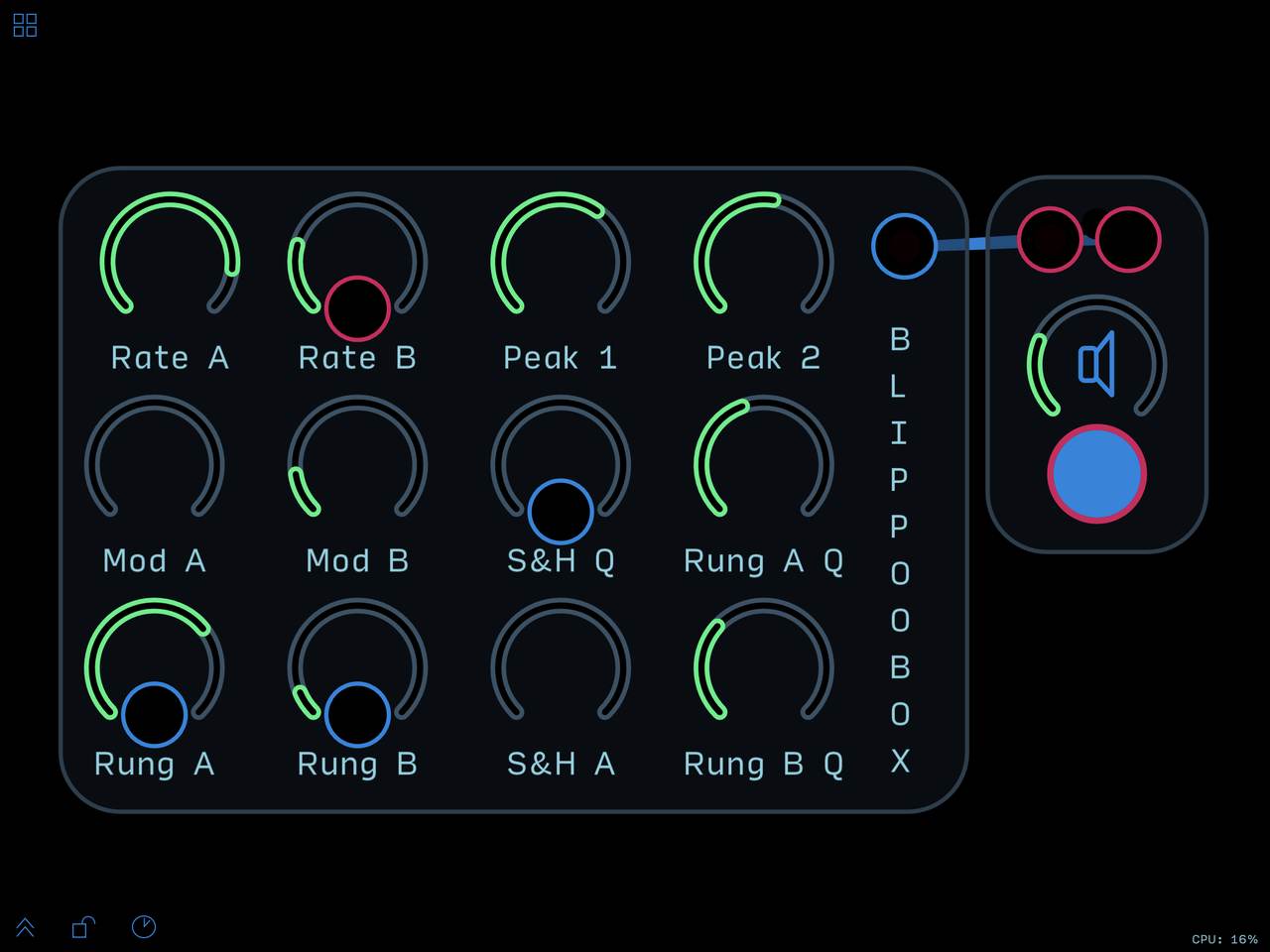
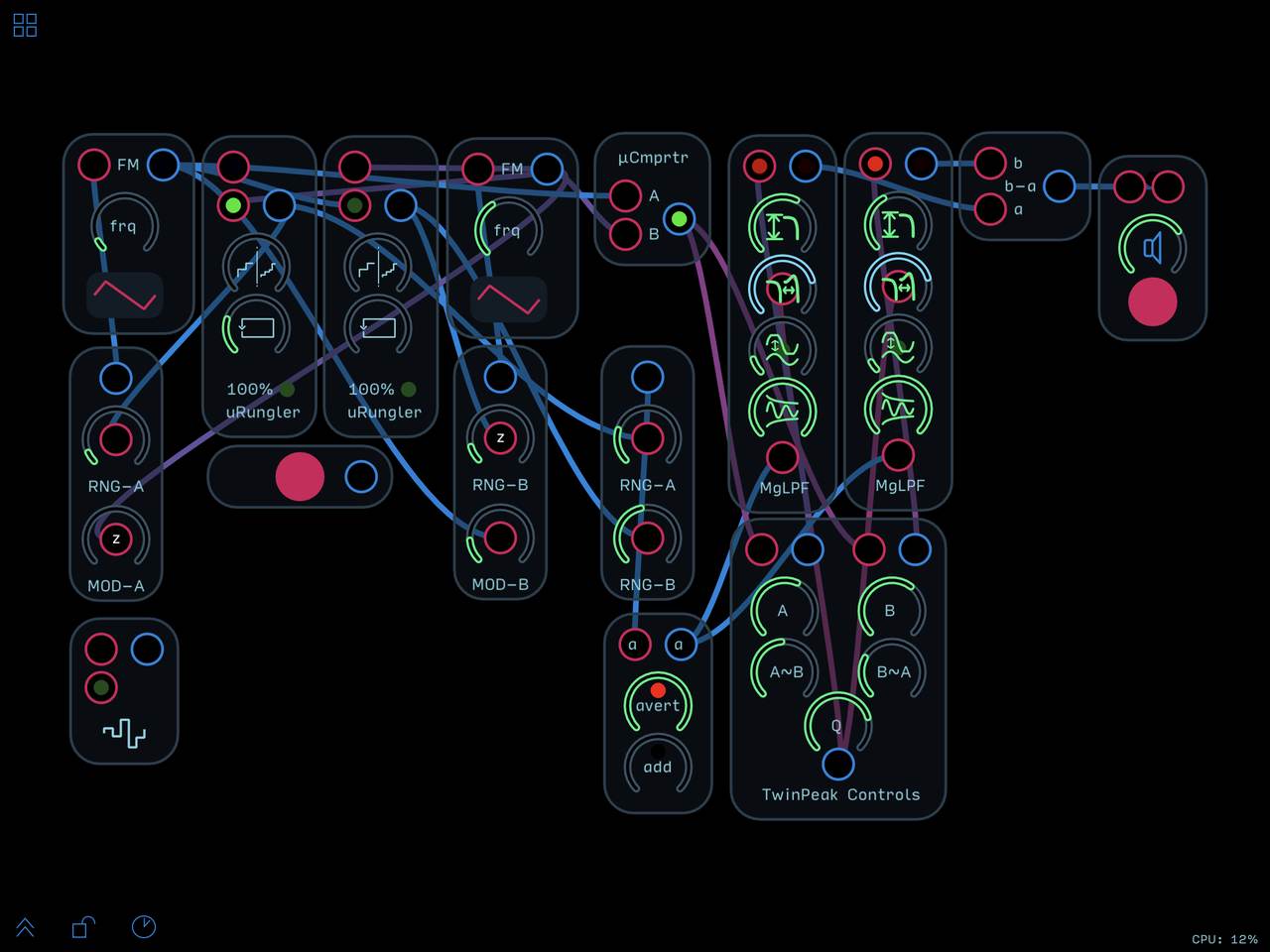
Here’s the current state of my Audulus Blippoo – now all collected in a box. I’m not sure if I’m quite happy with it yet. There were many things that I enjoyed in previous versions that I miss a little here. Having access to more of the TwinPeak filter for example. I’ve kept to the classic 12 knob setup for a start – perhaps I can play around with some alternatives later. The rungler core is now also in its perhaps most simple form – a simple kind of delay with no density or looping settings as in the Benjolin or Modular System Rungler Module. One of the tricky things is keep it from getting stuck for long periods of time. This happens for example when VCO A is running at a much slower rate than VCO B – and it’s in those situations that the S&H to Rate A is a handy dial to have.

I’m also not sure about all the internal sub-patches. They’ve been a very useful way of building it up, and even now when I’m still unsure about a lot of things and still thinking about possible changes, it’s handy to have it set up that way. But perhaps once it’s all figured out it could be worthwhile going back and rebuilding the patch with fewer sub-modules and a little less spaghetti.

Modular Diary – 076

Following up on yesterday’s z-1 UnitDelay considerations: STS discovered that his shift register design was unstable at audio frequencies and found a fix for it by including a z-1 node between each of its flip flops. He also mentioned some details of a fix in Hordijk’s Benjolin cicuit that helps avoid some of the more static sequences that the original Rungler could generate in certain cicumstances. Quite a learning experience this all has been!

Rob Hordijk in his Rungler Demo at Modular Meets Leeds:

If you design stuff, very quickly it becomes complex, then you have to simplify again, before you come with the final thing… if you make it too complex it becomes a pain in the ass to use…

Piecing a version of the Blippoo together step by step has made clear to me how many choices there are along the way, especially when choosing which controls to surface so that one has a playable instrument at the end of the day. It’s interesting to consider the Benjolin as a follow up on the Blippoo in that light too.

Modular Diary – 075

I spent the bits of time I had today further exploring the details of STS’s Audulus Rungler. The next step was to take his new shift register design and implement it in the Audulus Blippoo I’ve been putting together. I was wondering how to best implement the looping feature of the Rungler (even though it’s not actually featured in the Blippoo) when I noticed that STS had posted his take on recreating the Benjolin – in which he implements that feature beautifully!

Audulus helpfully pointed out to me that using the Audulus z-1 UnitDelay node in my Blippoo FM feedback loops would help improve the sound by processing them at audio rate. I first came across this node in the fascinating thread on non-linear filters and perhaps for that reason it stuck in my mind as a filter thing. The tip on using the UnitDelay was a good reminder that the Hordijk cicuits make good use of the blurred line between both oscillators and filters as (potentially chaotic) feedback systems.

Modular Diary – 074

Stschoen has been as productive as ever, this time with an Audulus version of the full modular system version of the Rob Hordijk’s Rungler.

I dove into exploring it alongside some videos of Hordijk himself demonstrating the module, as well as a little detective work concerning details that have fascinated me for some time. In his masterclass on Waveshaping and Fluctuation, Hordijk covers the waveforms of the Rungler VCO A – explaining the algorithm behind creating it’s ‘sine’ – or rather ‘parabol’ – waveform. That waveform provides the basis for his fluctuation modulation, which I’d looked at a while ago, and following that start I made some small changes to STS’ Rungler which hopefully bring the fluctuation waveforms closer to Hordijk’s design. The soft sync effects described at around 8 minutes in the Mallorca Rungler video also seem to work.

Modular Diary – 073

“A chaotic signal is not a random signal.” I got round to taking a look at Rob Hordijk’s recent Rungler Demo at Modular Meets Leeds 2017, a nice complement to the Mallorca demonstration from 2012.

One detail that I found very interesting was his demonstration of the patterns that can appear within a chaotic signal – the bifurcations or period doublings that can create harmonic partials that are lower in frequency than the signal fed into the filter.1 I’d noticed something like this in James Cigler’s TwinPeak demo yesterday, and had some fun trying it out myself with the filters in my Audulus Blippoo patch.

In essence, since a filter is a feedback system, the moment you apply non-linear feedback, the system automatically becomes potentially chaotic.

I also managed to implement a sample & hold in the Blippoo patch. Hordijk’s inclusion of a S&H in the design is interesting since the Rungler modulations already have something of a S&H character. I take it that including it had something to do with his observation that frequency modulation has a stronger effect when the modulating signal is lower in frequency than the one it is modulating. Using a S&H provided him with a useful device for effectively modulating low frequency periods such as envelopes, for example. In the Blippoo context the S&H definitely seems to add to the chaotic character of the patch rather than simply adding an extra FM modulation band when the modulating oscillator is higher in frequency.


  1. Hans Timmen refers to this on his website: “By using a nonlinear feedback system, patterns are created that exhibit chaotic properties like attractors, bifurcations, etc. Second, the filter also uses a nonlinear feedback system that can go into ranges where bifurcations occur, which results in the creation of ‘undertones’, where the period doublings create harmonic partials that are lower in frequency than the signal fed into the filter.” — Rob Hordijk ↩

Modular Diary – 072

I made a little more progress on my Audulus Blippoo today, with a pulse-width signal generated from a comparator between the two oscillators and, perhaps most importantly, a form of Twinpeak filter.

Once again I found it very useful to take a look at James Cigler’s demo and overview of the Epoch Modular TwinPeak (despite its somewhat shaky start).

The filter adds a lot of character to the chaotic core of the Blippoo, and its ingenious (again cross-modulating) design makes it a lot of fun to play with. I can imagine it being well worthwhile putting together a standalone version of it for use in other contexts.

A standalone Audulus (µ)module would require a little more thought into how the controls are linked up and presented – for the moment I’ve simply kept everything loosely connected since I’m still in a process of learning and discovering how the different parts affect the whole.

The next step is to implement the sample and hold.

Modular Diary – 071

With the Hordijk Putney-Revox patch in place I spent some time taking a fresh look at the schematics of the Blippoo, Benjolin, and Rungler circuits, slowly getting to know them a little better and understand the differences between them.

I also found James Cigler’s video tutorial on the Epoch Modular Benjolin useful in that it starts with a demonstration of the most straightforward aspects of the module before diving into the more chaotic modulations it is know for.

With that in mind I went back to my Putney-Revox patch, replacing the delays with Robert Syrett’s µRungler and starting to fill in the other connections. It’s a small beginning, I still need to add the S&H and comparator, and take a look at what could be done with the filter, but it’s fun to learn about what’s possible with the few elements that are in place, each step of the way.