rss

I’ve been catching up on lectures from the Darmstädter Ferienkurse 2016. They’re fortunately all available in audio form via Voice Republic with a handy podcast feed so that I can get them into Overcast.

I started off with Klaus Lang’s Liebe und Notation. Klaus was a fellow student back in the day when I studied composition with Younghi Pagh-Pahn in Bremen. He enjoyed the long trips from the Austrian mountains to the flat spaces of the German north: Creating open spaces happens to be one of the main features of his music.

The second lecture I’ve gotten round to has been Theater – Macht – Kritik – a concise overview of the changing views on theatre since the Greeks. I found it useful as a framework – as a tool for placing the kind of mindset (the director’s inszenierung as central focus) that Pelle Gudmundsen-Holmgreen came up against when getting his opera staged, as discussed at Frankenstein’s Lab last year.
100 Days of Something: 62

What are the building blocks that music shares with other capacities?

I came across this video1 of Fred Lerdahl’s lecture on Musical Syntax and Its Relation to Linguistic Syntax. Of particular interest to me since I’ve based a number of pieces of music directly on transcriptions of speech. Lerdahl also covers some interesting points worth considering when thinking of the common ground between music and other (art) forms.

This was the first of a series of three lectures. I haven’t been able to find videos of the following two: The Sounds of Poetry Viewed as Music and Tonal Space, Motion, and Force, but there is a PDF of the second available on Lerdahl’s website.

100 Days of Something: 60

Closing festival thoughts. The string quartet. Somewhere between the sinfoniettas and the vivid young ensembles: A classic formation with a ton of repertoire, but also with the potential of behaving like a band. Easily combined with multimedia, but equally happy without.

100 Days of Something: 59

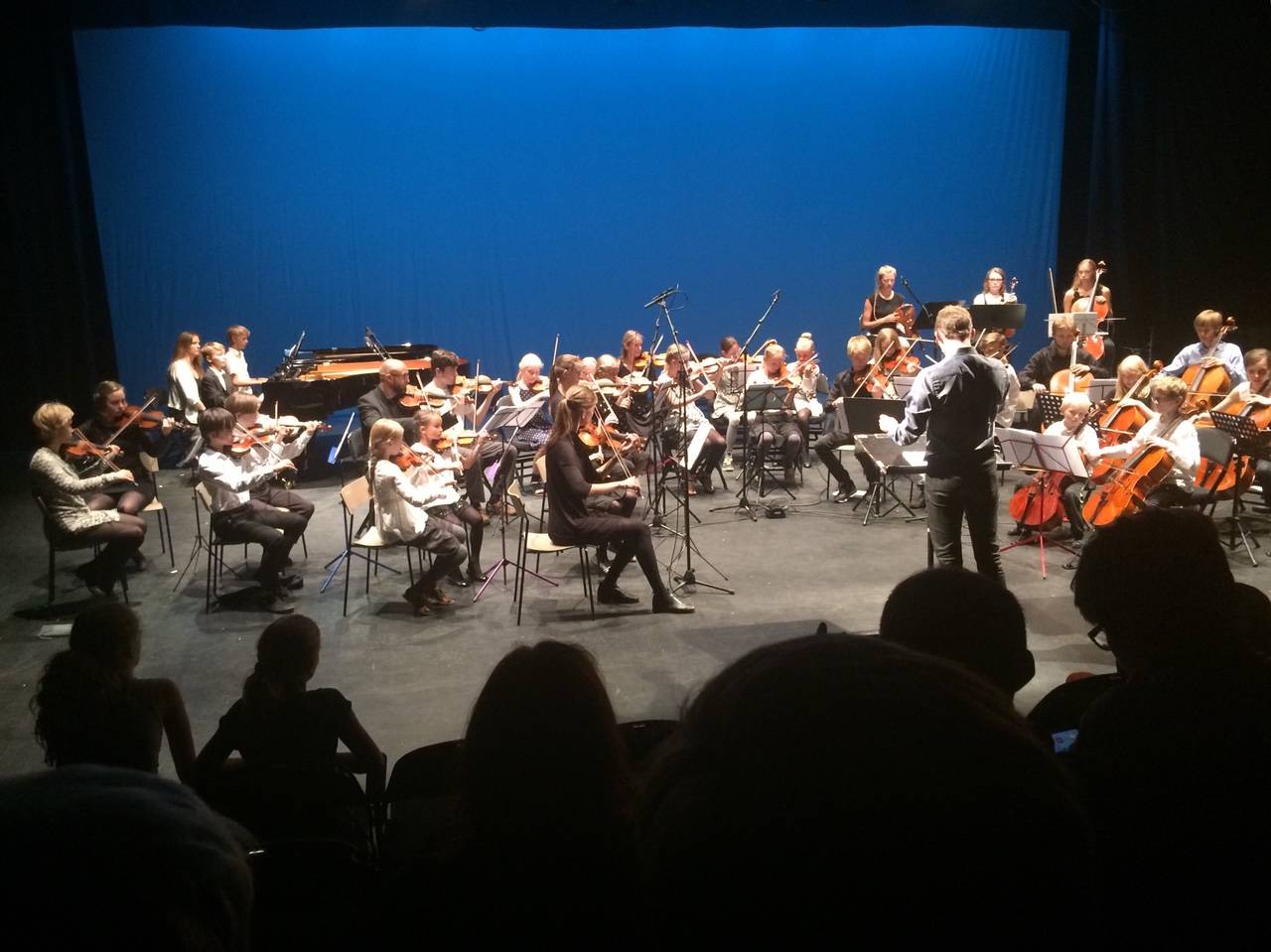
I attended an unusual concert this afternoon: children playing the avant-garde. Compositions by no less than Simon Steen-Andersen and Henning Christiansen, a text score by Carl Bergstrøm, and a large work specially composed for the Suzuki Institute by Peter Due. Rather than having the “see what the children can do” aspect in the foreground, I found myself caught up in experiencing the music.

Earlier in the day I happened to listen to a podcast with Steven Pinker – the cognitive psychologist well known for his theories on language. He had some thoughts on children being able to master a greater complexity of language than hitherto thought possible – and how this plays itself out in children’s books, for example.

100 Days of Something: 58

Some follow-up on yesterday’s post: Taking a listen to Celeste Oram’s Make it New report on Darmstadt 2014 again, here are the bits I was thinking of:

Celeste describes, at around 19′28″, the young ensembles as a “triple threat”:

Superb performers, with ambitious concepts for new models of musical performance, and their own stable of local composers whose work they champion.

Festival director Thomas Schäfer recognises this:

They are very flexible. They have very good ideas. Their structure is very anti-hierarchical. They are working in another way than ensembles 20–30 years ago.

He also recognises the need for a platform on which this “vivid ensemble scene” can present their art.

Later, at around 70′55″, he asks:

How can we work with the past? If we have a look at the young ensembles’ repertoires we will barely find any music that is older than 10 years, 10–15 years, so this is really something that we need contact to the important repertoire of former times, and try to bring it into a good conversation with current pieces.

100 Days of Something: 57

Late night thoughts a few days into Klang Festival 2016.

Has the Sinfonietta format reached the end of its life? As fantastic as the ensemble of soloists might be, it no longer seems the most suitable place for new pieces. While sinfonietta musicians seem closer to their orchestral cousins, younger groups like Distractfold and Pampelmousse are more like bands. Less tied to repertoire and institutional organisational apparatus, they seem closer to the music they are playing. More aware of considering their concerts as a whole.

Distractfold was awarded the Kranichsteiner prize at the Darmstadt Ferienkurze 2014. A little on them and the shape of todays young ensembles at the end of this RNZ report.

100 Days of Something: 56

Anders Monrad has been channelling his creative energies into apps during the last few years. Virtuoso, an iPhone app, coupled generative audio with visual elements and the iPhone’s motion sensors. He had the good idea of getting percussionist Ying-Hsueh Chen to create some performances using the app – a kind of dance with the iPhone with the graphic component projected as a background. That concept has been expanded upon in Sounding Images #1–6, performed, once again by Ying-Hsueh, at Klang Festival this evening.

100 Days of Something: 54

Last year, during a Frankenstein’s Lab excursion to the Illutron collective, we were introduced to the possibility of making a musical instrument out of a jet motor.

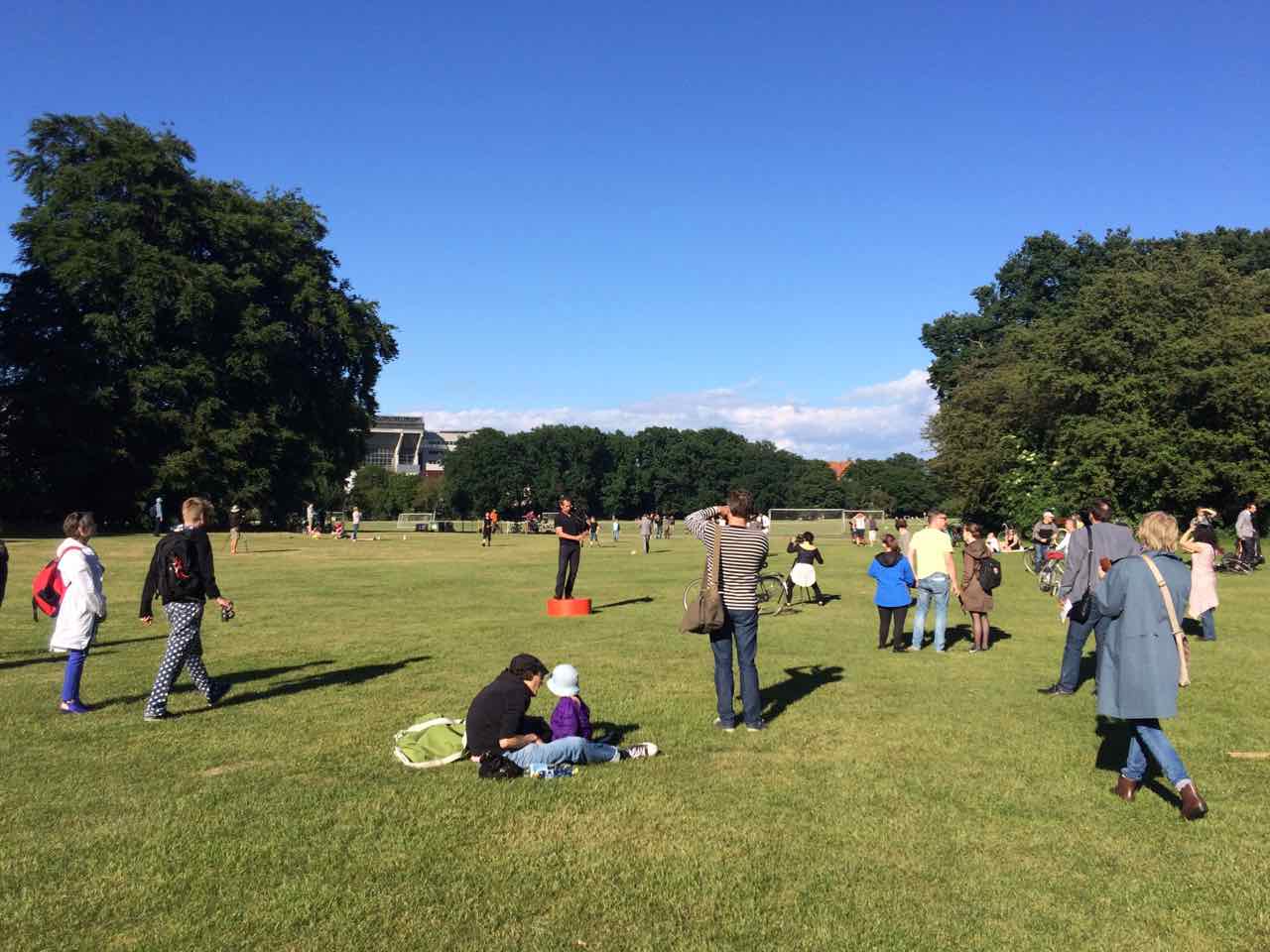
Today Lars Kynde, together with Illutron, presented a Pulsejet Symphony in Copenhagen’s Fælledparken as the opening of Klang Festival 2016. Erwan Keravec played the bagpipes while wandering between three Pulsejet trombones spread out in the park. From where I was standing it sounded something like this:

The next Frankenstein’s Lab will take place Monday 30 November in the Buckminster Fuller inspired Dome of Visions (situated next to the Black Diamond).

Yann Coppier will kick off the evening with a presentation of a new instrument, a kind of pedalboard developed specially for a theatre performance in which he wanted to get out from behind his computer. Knud Riishøjgaard will present an excerpt from his lecture performance Armed with Friendliness and Hanne Tofte Jespersen will present her If the Land could Talk, a ‘collaborative composition’ aimed at putting children in touch with nature.

101 Words – 090

I met with Jill Richards for lunch today. Jill is a wonderful pianist without whom a piece like Antjie in Berlin would probably never have come to life. She has wonderful Steinway (carefully pampered), and many happy hours have been spent in her living room listening to the seemingly never ending resonances of its strings.

While composers may be stepping into the role of performer more often these days, Jill is an example of an ever creative performer. An initiator, free improvisor, and participant in many multi-disciplinary collaborations, she has also been creating soundtracks and now even works involving actors!