rss

Modular Diary – 030

Interesting post on Synthtopia today on a web implementation of the 1971 Triadex Muse – a digital algorithmic sequencer. Donald Tillman, who implemented the sequencer in HTML5 and JavaScript, explains on his site that it includes a 31-bit shift register fed by the unusual ‘theme switches’ on the sequencer.

Shift registers are something that I first learned about via Rob Hordijk telling about the workings of his Rungler. In a masterclass on noise generators he explains the basic shift register principles and usage (at around 6′ in the video) before going on to tell a little about the history of how he first came to make use of it in a musical context (from around 10′50″ onwards) – and how a happy accident in that first encounter laid the ground for his Rungler, Benjolin, and Blippoo circuits.

The Audulus forum has also, once again, proved a fertile learning ground with an interesting discussion and example patches in the Rungler thread.
Modular Diary – 029

I’ve touched on my interest in alternate tunings in some previous posts. While taking a look at Keith Robert Murray’s site after coming across his explanation of linear FM, I discovered that he has a Eurorack arpeggiator module that also enables custom tunings. Equal divisions of the octave from 2–60 can be defined, and it is also possible to specify a custom tuning for each semitone.1 He explains it all in this video as well as demonstrating the fun one can have when combining alternate tunings with an arpeggiator.

Now all that would be missing for my taste would be the ability to define tunings according to ratio, and perhaps being able to combine the custom settings for individual notes with the ratios (or divisions other than EDO-12) as a starting point. Nevertheless some inspiration for creating something along similar lines in Audulus.


  1. Originally intended for making adjustments for non-standard or uncalibrated oscillators. ↩

Modular Diary – 028

I came across the Rob Hordijk’s Rungler in the Audulus forum a while ago and that particular module, as well as his system and approach in general, is something that I find myself repeatedly returning to.

The Rungler also forms the core of his Benjolin and Blippoo cicuits, and one element of it that I’ve found particularly fascinating is his Fluctuation modulation – a kind of combined FM/AM modulation that seems to have grown organically out of a double integrator algorithm used to round off the edges of a triangle wave. I haven’t quite figured out how to implement that algorithm directly in Audulus, but I did figure out that the edges could be rounded off a triangle wave in Audulus using the tanh (hyperbolic tangent) expression with similar results, and with that as a basis simply coupled regular AM and (linear) FM modulation to imitate Hordijk’s fluctuation – the only trick being to invert the AM signal so that the highest points of the FM correspond to the lowest points of the AM. Looking at the resulting waveform in a scope seems to come close to what Rob shows in this video around 16m10s.

Fluctuation is also used in Hordijk’s Triple LF-VCO and the result is an “extremely natural sounding vibrato, much gentler than with a normal LFO”, as explained on the Rob Hordijk information site.

I posted my first, somewhat rough, tryout in the Audulus forum a while ago and I’ve since been trying to refine the patch and experiment a little with what it sounds like at different frequencies. Robert Syrett has already put together something approaching a Benjolin (and a Rungler), and as the next steps in my own learning process I’m looking forward to figuring out my own implementation of a little more of the Rungler cicuit.

Modular Diary – 027

A week ago I wrote about (circular) mechanical sequencers and a lost post that I’d seen on a (re)construction of one for modular use. I still haven’t found the post, but in my searches for material on linear FM yesterday did come across this circular cardboard sequencer. There’s a fun video in addition the post on how to build it.

And that reminded me of some funny little bits tacked onto the end of some episodes of Reply All. Here’s one, and here’s another.

Modular Diary – 026

I particularly enjoyed the Cuckoo overview of FM principles that I came across in the Audulus forum thread on AM/FM/PM modulation.

I’ve since been wanting to take a closer look at the difference between linear and exponential frequency modulation and came across this video (also featuring an old ARP Oddysey Mk I) by Synthesizer Keith.

There’s a follow-up Reddit thread also clarifying that it’s linear modulation at play in the Yamaha DX style FM – the phase type of frequency modulation that Cuckoo refers to in his video – as well as a similar thread at KVR.

Keith refers to the Yamaha style linear FM as being “more musical” in his video, and there’s a Reddit thread, leading to a Muff Wiggler thread, on that question as well.

I found it interesting to look through the Wikipedia entry on Frequency modulation synthesis. I always associate FM with the 80s (the DX7!) but as the article points out Yamaha was already developing (and patenting) it (after famously licensing it from John Chowning1 ) in the mid 70s. It was only in 1980 that they’d developed the technology to a degree stable enough to release it commercially in the form of the curious Yamaha GS-1.

All of which was preceeded by Buchla with his own developments and implementations in the mid-60s.


  1. Chowning patented the digital implementation of FM in 1975. ↩

Modular Diary – 025

I went back and listened to the tryouts of the self-made TTSH that Jesper Pedersen posted on SoundCloud a while ago.1 (The Two Thousand Six Hundred is an unusual DIY clone of the ARP 2600.)

It’s interesting to think that while preceeding it by a year, the modular 2600’s production run is more or less parallel to that of the Oddysey. It’s a very particular sound those ARP instruments have!

In contrast to the punch of the first sequencer tryout that Jesper posted there’s also a warm drone and a more mellow sequence with some nice intonation and modulation details that appear as it progresses.


  1. “I began building hardware to take a little pause from software” he comments in the comments. ↩

Modular Diary – 024

Scratch the measurements from the last two days. I’ve been puzzled by the frequency readings I’ve gotten in Audulus – made using the Mic (External Input) 1 and ZeroCross nodes. (Calculating the deviations in cents was also done in with a little patch using the Audulus Hz2o (Hz to octave) module.)

I found a little tuner app that displays deviations in cents nice and clearly, and tried making some measurements with it directly via my iPhone’s microphone. I could set the ODDYSEi master tuning back to 440 and have the frequency register as a perfectly tuned A4 on the app – which is what one whould expect. The ODDYSEi Equal tuning matches equal temperament perfectly according to the tuner – which makes sense, also aurally! It turns out that Analogue tuning is calibrated to a near perfect A3 (220Hz) and gradually gets sharper as one moves up over the next 3 octaves. Inversely, moving down gradually gets flatter.

ARP ODDYSEi Analog tuning deviations in cents over 6 octaves:

A1 A2 A3 A4 A5 A6
A -39 -30 -1.2 4.8 10.6 16.5
A# -32 -7 -0.7 5.2 11.4 17.1
B -29 -12 0.2 5.6 12 17.6
C -15 22 0.5 6.2 12.4 18.2
C# -47 -19 0.9 6.9 12.9 18.8
D -44 -14 1.2 7.2 13.3 19.3
D# -19 -6 1.7 7.9 13.8 19.1
E -40 -5 2.4 8.4 14.3 20.4
F -30 -4 2.8 8.8 14.9 20.8
F# -10 -3 3 9.2 15.4 21.3
G -7 -2 3.8 9.8 15.8 21.5
G# -17 -2 4.2 10.2 16.1 22.1

(The measurements for the lower 2 octaves fluctuated a lot and were therefore more tricky to notate precisely.)


  1. Feeding the ARP ODDYSEi in via AudioBus. ↩

Modular Diary – 023

Here are yesterday’s measurements of the ARP ODDYSEi Equal and Analog tunings with the deviations from equal temperament indicated in cents.

ARP Equal (cents) 12-T.E.T (cents) ARP Analog
A 440 - 440 4 441
A# 466 - 466 7 468
B 494 - 494 7 496
C 524 2 523 9 526
C# 555 2 554 8 557
D 588 2 587 11 591
D# 624 5 622 10 626
E 661 5 659 12 664
F 700 4 698 14 704
F# 743 7 740 14 746
G 787 7 784 17 792
G# 835 9 830 19 840
A 884 8 880 20 890

Modular Diary – 022

Here’s a quick comparison of the differences between the Equal and Analog tunings on the ARP ODDYSEi – and how they compare to strict equal temperament. I’ve only measured one octave up from A = 440 Hz and am curious to measure how the tuning behaves in the other octaves as well. Interestingly I had to set the master tuning to 437.6 Hz on the ARP in order to get a measurement of 440 in Audulus. And the analyzer in MC Studio is showing pitches roughly 4 Hz below the equal measurements taken with Audulus. I’m not sure what’s going on there. Something to look into.

Equal Temp. ARP Equal ARP Analog
A  440 440 441
A# 466 466 468
B 494 494 496
C 523 524 526
D# 554 555 557
D 587 588 591
D# 622 624 626
E 659 661 664
F 698 700 704
F# 740 743 746
G 784 787 792
G# 831 835 840
A 880 884 890

The next step is to calculate the deviations in cents.

Modular Diary – 021

I‘ve been taking a look at putting together a quantizer for custom tunings in Audulus – there’s been a little activity on that front in the forum. I have in mind something that builds on the small ratio modules that I was using to tune a sequencer in a previous post. Something very flexible that can be changed on the fly with the possibility of additional ‘hand-tuned’ deviations from the basic ratios. A kind of hybrid between systematic and empirical tuning.

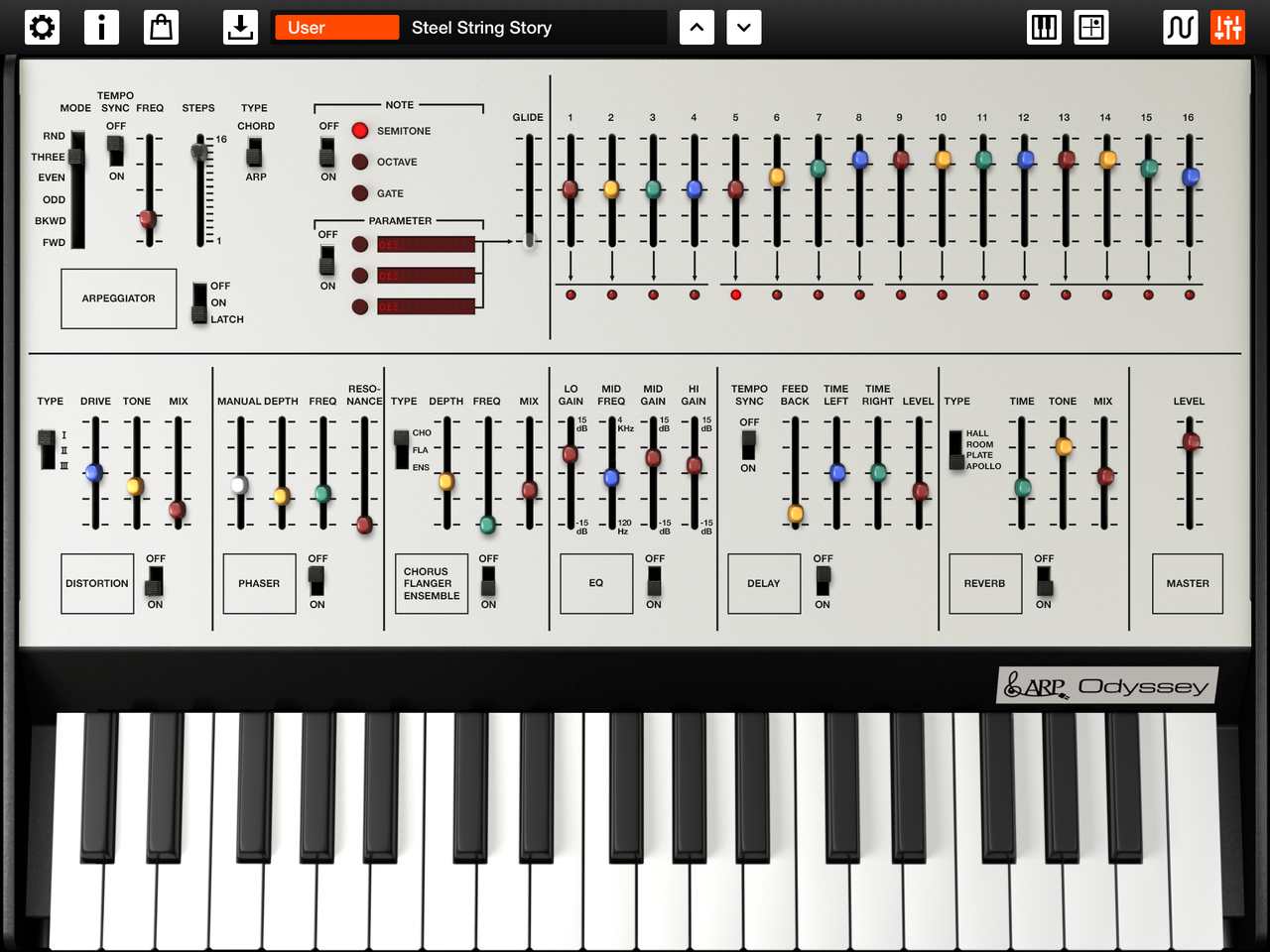
Since it’s taking me a little time to figure it all out here’s a little experiment with changing the tuning on the ARP ODYSSEi from Equal to Analog while running a simple sequence. The deviations are subtle but nevertheless quite noticeable (often a little flat in relation to equal temperament) – at some point it could be interesting to measure them precisely and put together a little list that could be used in other contexts.1

Here’s the unadorned sequence – two cycles in equal temperament followed by two with the analogue tuning:

ARP Equal Analogue

And a longer jam trying out the analogue tuning at different transpositions as well as playing with the length of the sequence.

ARP ODYSSEi Analogue Sequence

  1. See, again the Richard D. James interview with Tatsuja Takahashi. ↩