rss

Modular Diary – 024

Scratch the measurements from the last two days. I’ve been puzzled by the frequency readings I’ve gotten in Audulus – made using the Mic (External Input) 1 and ZeroCross nodes. (Calculating the deviations in cents was also done in with a little patch using the Audulus Hz2o (Hz to octave) module.)

I found a little tuner app that displays deviations in cents nice and clearly, and tried making some measurements with it directly via my iPhone’s microphone. I could set the ODDYSEi master tuning back to 440 and have the frequency register as a perfectly tuned A4 on the app – which is what one whould expect. The ODDYSEi Equal tuning matches equal temperament perfectly according to the tuner – which makes sense, also aurally! It turns out that Analogue tuning is calibrated to a near perfect A3 (220Hz) and gradually gets sharper as one moves up over the next 3 octaves. Inversely, moving down gradually gets flatter.

ARP ODDYSEi Analog tuning deviations in cents over 6 octaves:

A1 A2 A3 A4 A5 A6
A -39 -30 -1.2 4.8 10.6 16.5
A# -32 -7 -0.7 5.2 11.4 17.1
B -29 -12 0.2 5.6 12 17.6
C -15 22 0.5 6.2 12.4 18.2
C# -47 -19 0.9 6.9 12.9 18.8
D -44 -14 1.2 7.2 13.3 19.3
D# -19 -6 1.7 7.9 13.8 19.1
E -40 -5 2.4 8.4 14.3 20.4
F -30 -4 2.8 8.8 14.9 20.8
F# -10 -3 3 9.2 15.4 21.3
G -7 -2 3.8 9.8 15.8 21.5
G# -17 -2 4.2 10.2 16.1 22.1

(The measurements for the lower 2 octaves fluctuated a lot and were therefore more tricky to notate precisely.)
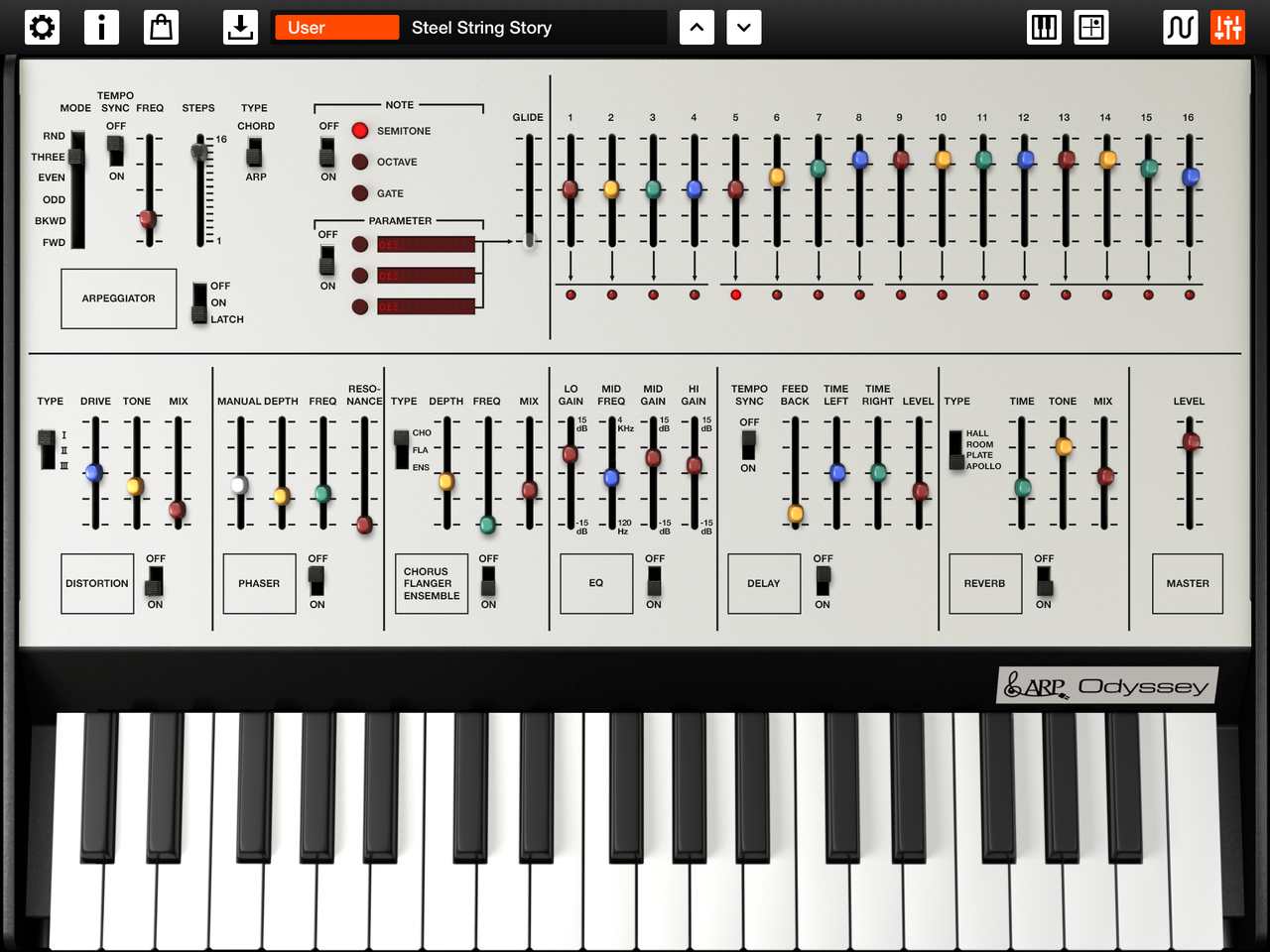
  1. Feeding the ARP ODDYSEi in via AudioBus. ↩

Modular Diary – 023

Here are yesterday’s measurements of the ARP ODDYSEi Equal and Analog tunings with the deviations from equal temperament indicated in cents.

ARP Equal (cents) 12-T.E.T (cents) ARP Analog
A 440 - 440 4 441
A# 466 - 466 7 468
B 494 - 494 7 496
C 524 2 523 9 526
C# 555 2 554 8 557
D 588 2 587 11 591
D# 624 5 622 10 626
E 661 5 659 12 664
F 700 4 698 14 704
F# 743 7 740 14 746
G 787 7 784 17 792
G# 835 9 830 19 840
A 884 8 880 20 890

Modular Diary – 022

Here’s a quick comparison of the differences between the Equal and Analog tunings on the ARP ODDYSEi – and how they compare to strict equal temperament. I’ve only measured one octave up from A = 440 Hz and am curious to measure how the tuning behaves in the other octaves as well. Interestingly I had to set the master tuning to 437.6 Hz on the ARP in order to get a measurement of 440 in Audulus. And the analyzer in MC Studio is showing pitches roughly 4 Hz below the equal measurements taken with Audulus. I’m not sure what’s going on there. Something to look into.

Equal Temp. ARP Equal ARP Analog
A  440 440 441
A# 466 466 468
B 494 494 496
C 523 524 526
D# 554 555 557
D 587 588 591
D# 622 624 626
E 659 661 664
F 698 700 704
F# 740 743 746
G 784 787 792
G# 831 835 840
A 880 884 890

The next step is to calculate the deviations in cents.

Modular Diary – 021

I‘ve been taking a look at putting together a quantizer for custom tunings in Audulus – there’s been a little activity on that front in the forum. I have in mind something that builds on the small ratio modules that I was using to tune a sequencer in a previous post. Something very flexible that can be changed on the fly with the possibility of additional ‘hand-tuned’ deviations from the basic ratios. A kind of hybrid between systematic and empirical tuning.

Since it’s taking me a little time to figure it all out here’s a little experiment with changing the tuning on the ARP ODYSSEi from Equal to Analog while running a simple sequence. The deviations are subtle but nevertheless quite noticeable (often a little flat in relation to equal temperament) – at some point it could be interesting to measure them precisely and put together a little list that could be used in other contexts.1

Here’s the unadorned sequence – two cycles in equal temperament followed by two with the analogue tuning:

ARP Equal Analogue

And a longer jam trying out the analogue tuning at different transpositions as well as playing with the length of the sequence.

ARP ODYSSEi Analogue Sequence

  1. See, again the Richard D. James interview with Tatsuja Takahashi. ↩

Modular Diary – 012

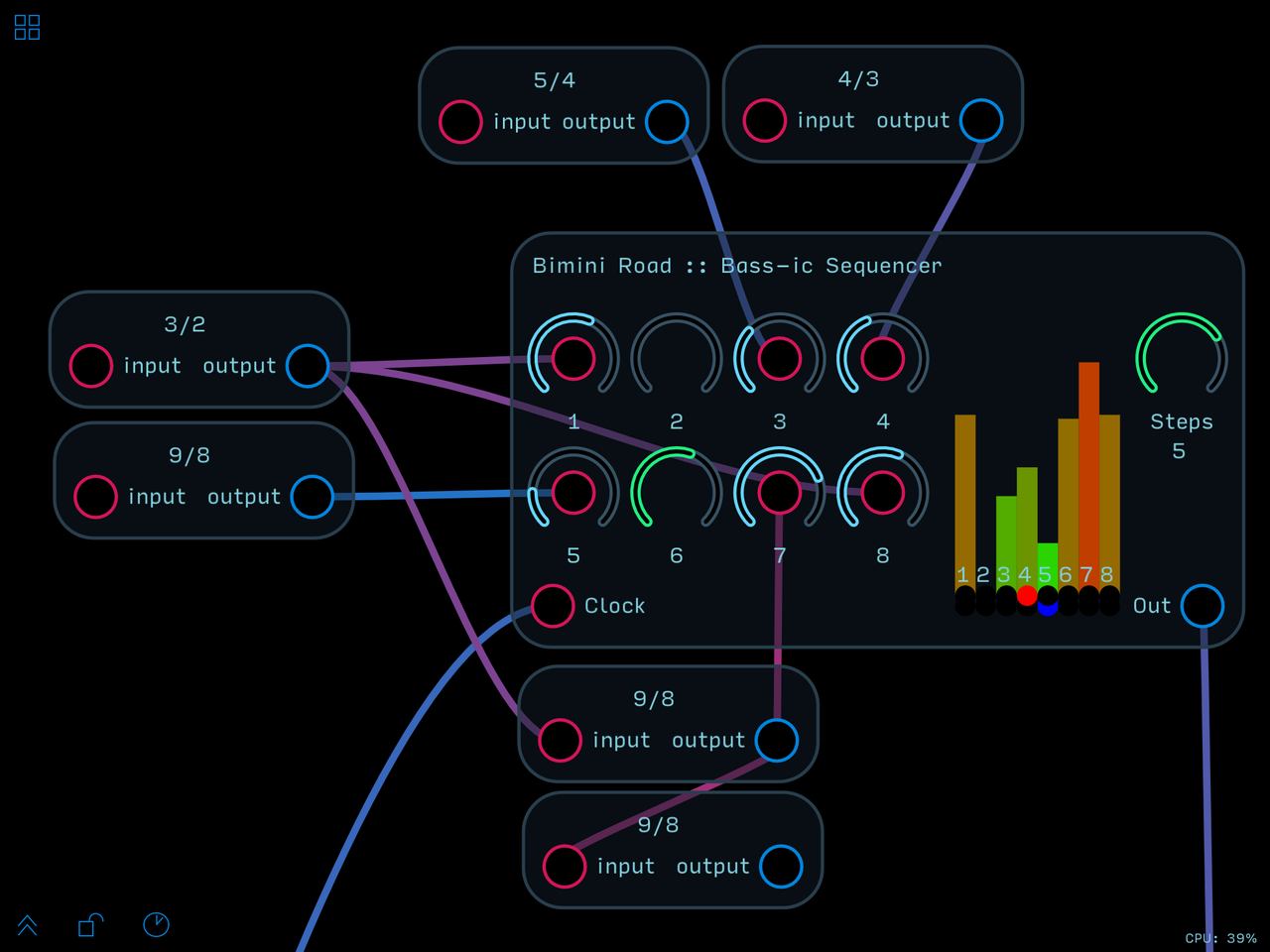
With Audulus, as with most modular systems, the sequencer ‘control voltages’ are typically quantized before being passed on to an oscillator. I was keen to try out tunings with pure ratios and at first thought of piecing together a just intonation quantizer. However, since the sequencer knobs are fluid, it occurred to me that I could simply put together a small collection of ratio modules and connect them freely to the knobs. In this way some steps might be purely tuned while others could be set empirically.

The modules have an inbuilt reference pitch of 440Hz – that means that the 3:2 ratio will produce a pitch a perfect fifth above 440Hz. If the input is connected to a keyboard (or other) source the ratio will take that input as it’s starting point. The modules can be strung together so that the output of the 3:2 module can be connected to the input of a 9:8 module for example – producing a just second above the pure fifth.

Here’s an Audulus patch (very much a tryout, with the inclusion of all kinds of other bits and pieces I was experimenting with) demonstrating the approach.

Audulus Basic Sequencer Tryout

Modular Diary – 010

Perhaps the most interesting aspect of the Richard D. James interview is his approach to tunings – thinking back over the Aphex Twin catalogue it becomes clear just how much they are an integral part of his sound(s). I was especially intrigued by his mixing systemised tuning with notes that are empirically chosen. And his thoughts on how sequencer patterns can can evolve when combined with custom tuning set-ups.

I’m still surprised by the extent that the modular world, having largely emancipated itself from keyboard thinking, seems to largely stick to equal temperament with it’s quantizers. Perhaps there’s been a greater focus on timbre, and the there’s the challenge of keeping voltage controlled oscillators in tune over a wide range, but as is clear with Aphex Twin, timbre and tuning are related.

Individual oscillators can of course be tuned exactly as one wants to. I experimented a little with the Moog Model 15 App, with the tooltip coming in handy when trying to nail pure intervals between the two oscillators. It’s also possible to set up equal distance scales (with divisions other than twelve) by attenuating the keyboard/input voltage.1 Arpeggiator pitches are quantized but it is possibile to use the fluid velocity output to control the pitch of the oscillators – the only catch is that one can’t zoom in on the arpeggiator controls as one can with the modules.


  1. Moog includes a 15 note EDO microtonal organ preset that does this. ↩