rss

Modular Diary – 053

While playing around creating drone-like textures with STS’s Turing Machine, I got to thinking of Pugix’s Audulus Quantussy drones that I came across in the forum a few weeks ago. He has a nice post on his website explaining it all along with some sound examples.

I was curious to take a look at the hardware Quantussy (What is the Quantussy?) that provided the inspiration for Richard’s version, and that led me to some of the most unusual modules I’ve yet come across. As described on the website:

Ciat-Lonbarde specializes in intuitive analog organs for your atonal/chaos squishing needs. The following instruments are assembled in Baltimore out of local wood, and machine assembled circuit-boards that are hazmat free.

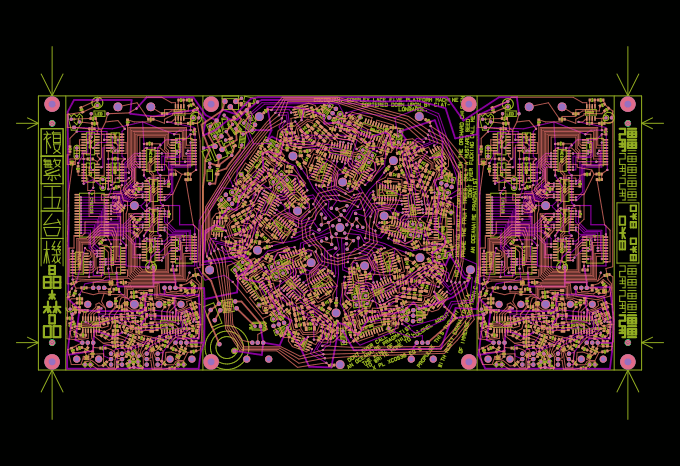
The circuit boards are works of art in themselves. Here’s a Reddit Inquiry into the artsy-hipster side of Synthesis, and an ilovefuzz.com thread with a number of videos of these instruments in action.

Modular Diary – 017

The interesting thing with modular systems is that things can be fed back into themselves. The O-Coast Krell that got me started with all of this is a good example. The generative aspect puts one in a very different position from the prog rock ‘keyboard wizard’ of the 70s. The person ‘playing’ the modular is potentially both listener and performer.1

Oscillators and filters can be feedback loops within themselves – which can then be connected together to form larger systems in which everything feeds back into everything else. Cicuits such as Rob Hordijk’s Rungler, Benjolin and Blippoo Box embrace the chaotic behaviour that can arise, with the player more in the role of steering the direction of the sound than using it as a form of ‘expression’.

Nicky Case recently presented a wonderful talk at The Long Now Foundation: Seeing Whole Systems. He visualises differences between linear cause and effect thinking, and complex systems in which everything influences everything else, covering examples from nature and social constellations to health and economics. He suggests some tools (and has also written games and apps) that might help us learn how to steer and play the chaos.

And that’s exactly what a lot of modular people are doing.


  1. See Walker Farrell’s thoughts on his own back and forth bewteen generative systems and improvisational input in the Cycling 74 interview with Zeos Greene. ↩