pas une the for art and are now can
our not yet old her bits
Spa All far who one
ago was put web
but
Guy few his U.S.A how pop
out use has you I’ve
eye act oil art
one cut
led war she
see
say you way spy
aim had Jen its
his two
RSS
low out fox
gems
lot
too
via boy
may
age
101 ask
full
get off box fun
dug
men São New
ten
own all
red
got six day run 370
Sea dry
120
law dogs
TGD
Pet
Joy
will sit any
fill
100 200
Ceci n’est pas une publisher – a seminar I attended today on “the role of music publishers in tomorrow’s environment for art music.”
If the notion of the ‘work’ is on the way to being more action than object, and performers are increasingly creative partners, where does that leave libraries and publishers? Given that individuals now have so many channels available to them, where does that leave the institutions built up around orchestras, ensembles, and broadcasting?
I keep returning to Harry Lehmann’s analysis: The institutions continue, albeit in a weaker form.
Free agents collaborating with them can be healthy for both parties.
one
day the
the man got
man got his big
got his big kit out
his big buy out
big act out
kit out
out

one
day the
the man got
man got his big
got his big cry out
his big art out
big toy out
cry out
out

one
day the
the man got
man got his big
got his big eye out
his big try out
big god out
eye out
out

one
day the
the man got
man got his big
got his big hit out
his big pay out
big run out
hit out
out I’m amazed at the fascination books and screens hold for our not-quite-yet-four-month-old daughter. I never imagined that it would start so soon. Her fine little fingers couldn’t be held back from the screen of my iPhone this morning and produced the following string of emojis:
👨❤️💋👨👄💉👙🕕🔵🔸⚫️🎂💌💍🏊🏻
My wife and I are celebrating our 9th wedding anniversary today and it’s easy to read various bits of the story of our relationship into those small pictures – I guess that’s part of what’s so great about them. A little private picture novel even though the meaning is just between us.
An email from a good friend in my inbox this afternoon – informing me about Doom Spa V – Good Luck To Us All, a “three-hour performance with live music of cool white beauty”. There’s also a Tumbler with sketches for various versions of it. Worpswede (not far from where I studied when first arriving in Europe) and Paula Modersohn Becker (who painted Rilke) are in there too. Letters about being frightened of a coming age in which one can speak to everyone about everything.
Scrolling down (almost) to the bottom there’s a video of Felix playing the piano in white pants.
On this day in 1902, in Paris, Rilke wrote Herbsttag – a poem about the suspended moment between late Summer and the impending Autumn.
A few years ago I composed a piece of music around it. Not so much a setting as an unfolding of the speech-melodies of Anette Slaatto (the violist for which it was written) reading the poem aloud.
I also put together a simple web presentation in which Rilke’s text appears timed to the music that has grown out of it: An attempt to provide a frame of focus for experiencing the piece when listening on the web.
Having so much at my fingertips (since hopping on Apple Music) at first made it possible to revisit some old (teenage) favourites, but mostly I’ve ended up listening to Sufjan Stevens and Iron & Wine playlists, which is not what I’d have listened to in the past. I’ve been wondering whether Chloe Weil was on the right track with her Sound of Summer. That in a future in which access to music is no longer the issue it’ll be not records, but records of what was meaningful to us at a particular time that’ll be important – something the music services aren’t onto.
A few days ago I caught up on the latest episode of Inquisitive: Guy English talking about his favourite album – Nebraska.
The Bruce Springsteen I knew as a teenager was very much the Springsteen of Born in the U.S.A, and, much like Guy, it was never really my thing (although I clearly remember Hungry Heart as a boy discovering radio for the first time). Nebraska though, shows a very different side of Springsteen, colouring everything else he’s done once you’ve gotten to know it.
Nebraska reminds me of just how strong music can be.
(In contrast to today’s Scandinavian pop factories.)
The last in this little Ultima trilogy:
A fine interview with Matmos’ Drew Daniel covering our changing relations to television (and opera), as well as Cage, nature, and the slices out of the whole that occur when using microphones or creating art.
In talking about Robert Ashley’s unique use of language:
The cadence and delivery of speech already has musicality in it, and becomes a fascinating, capacious and beautiful phenomenon when you can sharpen it and deliver it with the right kind of intensity.
I’ve been attempting something similar with my speech melody stuff. Ashley seems to achieve it so effortlessly.
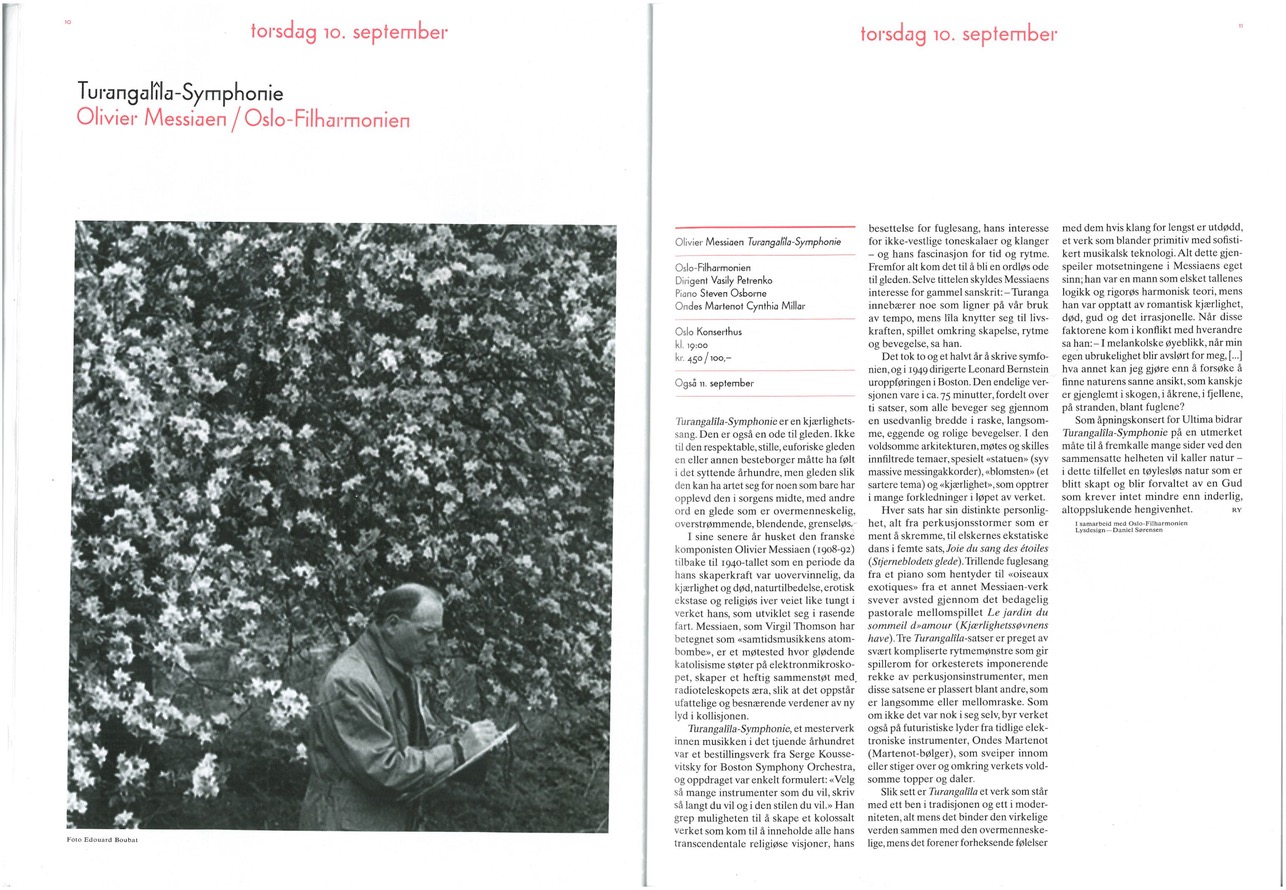
I wasn’t in Oslo for the Matmos/Ashley performance, but looking through the festival booklet a photograph of Messiaen notating birdsong under the foliage of a large tree did catch my eye. A beautiful photograph that conveys something of the act of listening, I made an oil painting of it while taking art classes many years ago. Looking at it again reminded me that Messiaen, in answer to my question of there being an equivalent to sketching in music, took some steps in this direction – even though those notations, incorporated into large works, were never really presented as small standalone pieces.