rss

Modular Diary – 028

I came across the Rob Hordijk’s Rungler in the Audulus forum a while ago and that particular module, as well as his system and approach in general, is something that I find myself repeatedly returning to.

The Rungler also forms the core of his Benjolin and Blippoo cicuits, and one element of it that I’ve found particularly fascinating is his Fluctuation modulation – a kind of combined FM/AM modulation that seems to have grown organically out of a double integrator algorithm used to round off the edges of a triangle wave. I haven’t quite figured out how to implement that algorithm directly in Audulus, but I did figure out that the edges could be rounded off a triangle wave in Audulus using the tanh (hyperbolic tangent) expression with similar results, and with that as a basis simply coupled regular AM and (linear) FM modulation to imitate Hordijk’s fluctuation – the only trick being to invert the AM signal so that the highest points of the FM correspond to the lowest points of the AM. Looking at the resulting waveform in a scope seems to come close to what Rob shows in this video around 16m10s.

Fluctuation is also used in Hordijk’s Triple LF-VCO and the result is an “extremely natural sounding vibrato, much gentler than with a normal LFO”, as explained on the Rob Hordijk information site.

I posted my first, somewhat rough, tryout in the Audulus forum a while ago and I’ve since been trying to refine the patch and experiment a little with what it sounds like at different frequencies. Robert Syrett has already put together something approaching a Benjolin (and a Rungler), and as the next steps in my own learning process I’m looking forward to figuring out my own implementation of a little more of the Rungler cicuit.
Modular Diary – 029

I’ve touched on my interest in alternate tunings in some previous posts. While taking a look at Keith Robert Murray’s site after coming across his explanation of linear FM, I discovered that he has a Eurorack arpeggiator module that also enables custom tunings. Equal divisions of the octave from 2–60 can be defined, and it is also possible to specify a custom tuning for each semitone.1 He explains it all in this video as well as demonstrating the fun one can have when combining alternate tunings with an arpeggiator.

Now all that would be missing for my taste would be the ability to define tunings according to ratio, and perhaps being able to combine the custom settings for individual notes with the ratios (or divisions other than EDO-12) as a starting point. Nevertheless some inspiration for creating something along similar lines in Audulus.


  1. Originally intended for making adjustments for non-standard or uncalibrated oscillators. ↩

Modular Diary – 030

Interesting post on Synthtopia today on a web implementation of the 1971 Triadex Muse – a digital algorithmic sequencer. Donald Tillman, who implemented the sequencer in HTML5 and JavaScript, explains on his site that it includes a 31-bit shift register fed by the unusual ‘theme switches’ on the sequencer.

Shift registers are something that I first learned about via Rob Hordijk telling about the workings of his Rungler. In a masterclass on noise generators he explains the basic shift register principles and usage (at around 6′ in the video) before going on to tell a little about the history of how he first came to make use of it in a musical context (from around 10′50″ onwards) – and how a happy accident in that first encounter laid the ground for his Rungler, Benjolin, and Blippoo circuits.

The Audulus forum has also, once again, proved a fertile learning ground with an interesting discussion and example patches in the Rungler thread.

Modular Diary – 031

Having made a start on recreating Rob Hordijk’s fluctuation waveform I’ve now been trying to clarify for myself the sync aspect of this type of modulation – the way the modulated signal syncs with the modulating signal.

Hard sync is fairly easy to understand but soft sync, which is what is at play in Hordijk’s fluctuation can have many different forms. The Hordijk info site explains the fluctuation soft sync as follows:

The “fluctuation” modulation is a combination of AM and FM which soft syncs to the harmonics of the modulating signal.

Hordijk himself provides a little more detail in his Waveshaping & Fluctuation masterclass:

…when you come to the extreme points then it sort of forces it to zero again, but only if it is within a certain distance and that means that it basically tries to sync on harmonics, but traditional soft sync in an oscillator actually syncs on higher harmonics, but this actually syncs, soft syncs on subharmonics, so the modulating oscillator needs to be higher than the fluctuated modulator, oscillator, which with normal soft sync would be the other way around, so it’s not really soft sync, so I cannot call it soft sync, so I had to give it another name and I thought well maybe Fluctuation is a nice name, and so I call it Fluctuation…

Hordijk’s explanation brings up something else that I’ve had to clarify for myself – what exactly it is he means by subharmonics. The possible definition of subharmonics as “integral submultiples of the fundamental (driving) frequency” offered by the Wikipedia article seems to help here. I simply take it to mean that since the modulating oscillator is higher than the one it is causing to fluctuate, the modulated oscillator syncs at subdivisions of the modulating frequency, rather than multiples.

Now how does one do that in Audulus?

Modular Diary – 032

It’s interesting how one can keep circling around a topic, slowly covering all it’s aspects and letting them sink in.

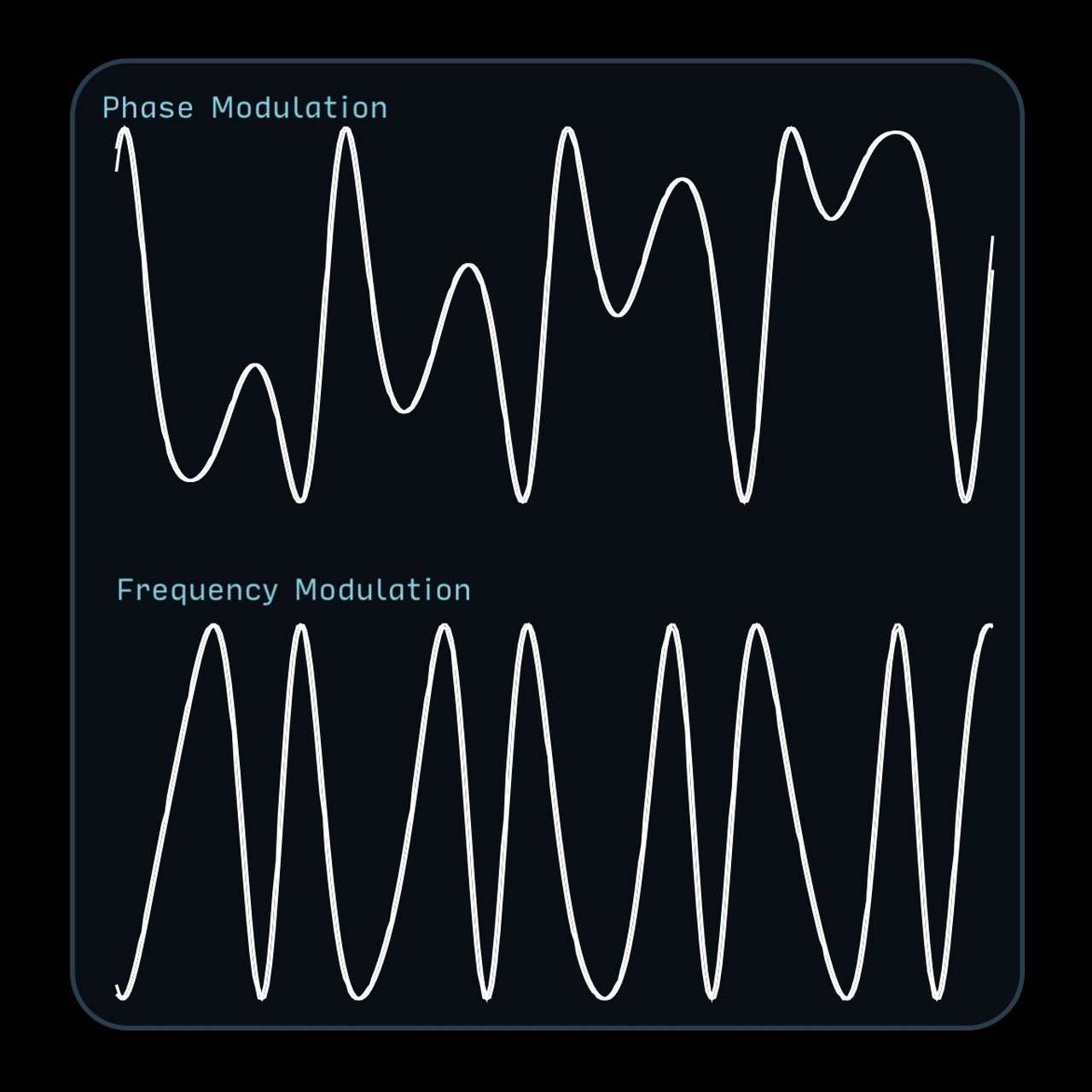
I’ve been taking a look at frequency modulation again – specifically the difference between phase and frequency modulation that I touched on in a previous post. Phase modulation (as used in the Yamaha DX synthesizers) has the same (linear) effect as linear frequency modulation, but while mathematically equivalent, the two sound very different. I came across a thread in the Audulus forum that I’d somehow overlooked before, in which Robert Syrett provides an example patch that helps clarify the differences.

Here’s my own slightly altered version of his patch that I’ve been playing around with. I haven’t quite managed to match the nice phase gif from the Wikipedia phase modulation article, but that can be explored further on another day.

Modular Diary – 033

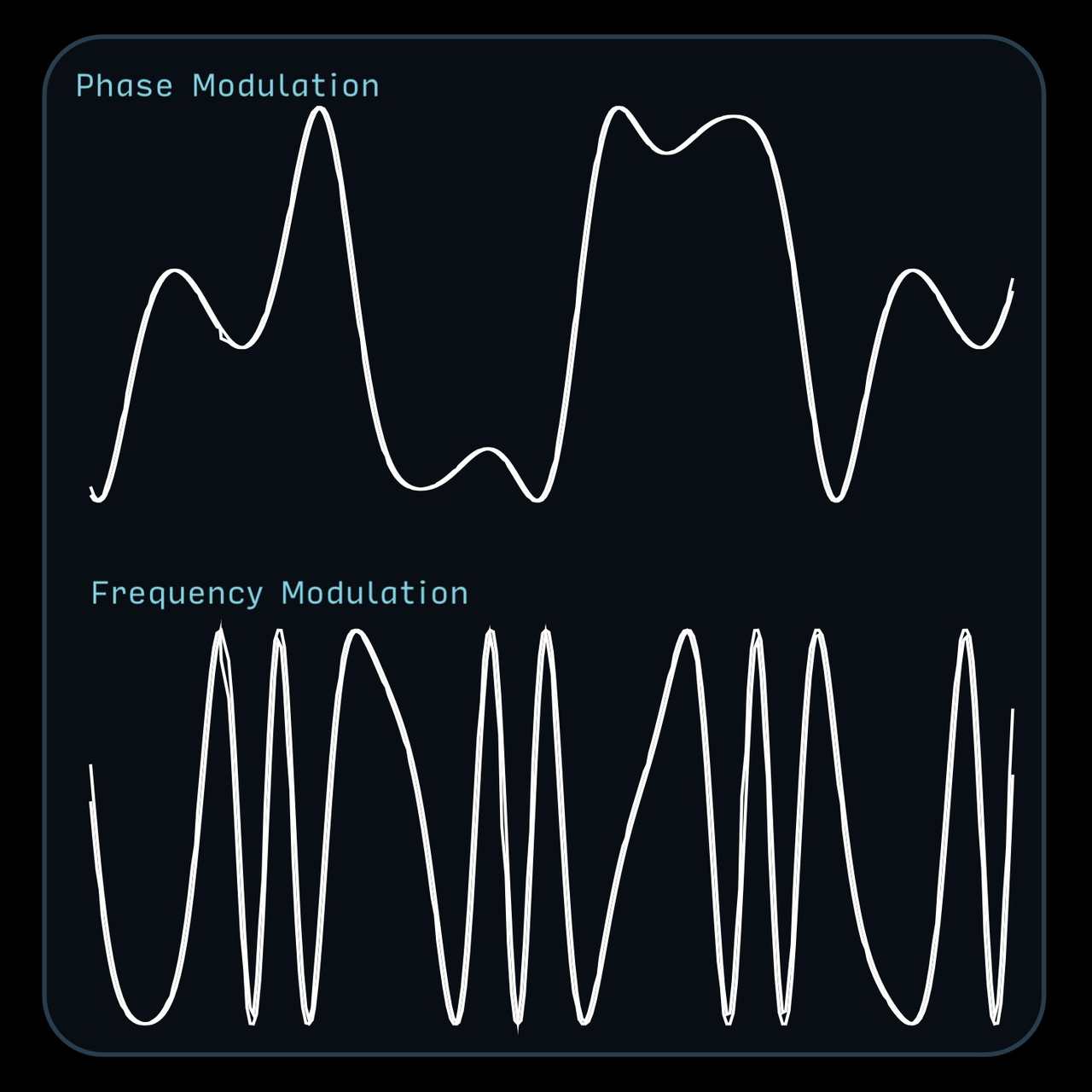
Further down the phase/frequency modulation rabbit hole: I’ve played around a little more with the PM vs FM patch (uploaded to the Audulus forum) and got the levels set to recreate the Wikipedia phase modulation gif. The Audulus LFO waveforms are unipolar and I experimented at little, comparing the results with using a bipolar modulating waveform on the linear1 and exponential FM inputs.

I’ve also been looking at how the shapes change depending on whether the modulating frequency is higher or lower than the one it is modulating. The characteristic phase shapes (with amplitude sub-peaks within them) appear when the modulating wave is higher than the carrier, having a much stronger effect in this area than linear or exponential frequency modulation.


  1. This results in a folding effect similar to the phase modulation amplitude sub-peaks in the picture above. ↩

Modular Diary – 034

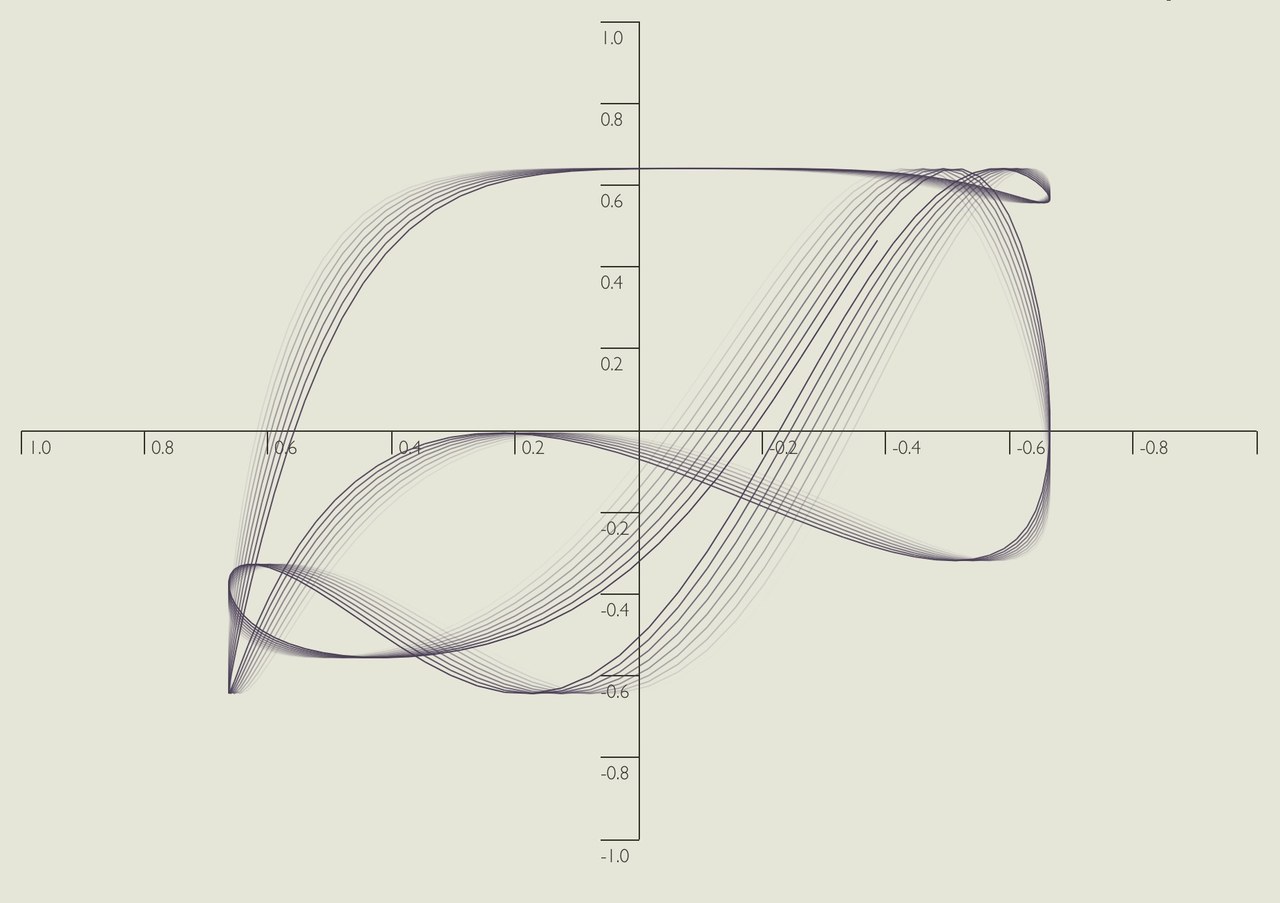
Phase Art: The picture above is of the Wikipedia 3:2 phase modulation example 1 and corresponding comparison with frequency modulation as displayed by an oscilloscope in X-Y mode.2 This is a mode typically used for testing phase relationships between signals and is well known as the method for displaying Lissajous curves – a sine wave on the X axis and a cosine wave on the Y creates a perfect circle, for example.

What I hadn’t realized is that a phase modulated signal against the same (unmodulated) reference frequency could create the kinds of shapes above. (The frequency modulated signal against the same unmodulated reference frequency produces a rotating oval.3) In this case the phase and (linear) frequency modulated signals are presented simultaneously, resulting in the bands of lines that look something like a staff in music notation.


  1. In this case 750:500 Hz ↩

  2. In this case the Goniometer in the MC Studio app.  ↩

  3. Playing with the linear frequency index (the degree to which it approaches exponential frequency modulation) alters the number of lines present and their proximity. The more exponential the curve, the more one approaches familiar Lissajous territory. ↩

Modular Diary – 035

Following on Hordijk’s fluctuation modulation, here’s a demo that I saw a while ago that’s been popping into my head, on how to program the lead sound for Vangelis’ Blade Runner theme. There’s a section on vibrato that starts around 4′23″.

I also took another look at the effects of uni and bipolar waveforms on linear FM in Robert Syrett’s Audulus Bahama oscillators – unipolar FM alters the perceived pitch (which makes sense for audible frequencies 1 since the modulation is only in an upward direction) while bipolar waveforms keep it centered. I noticed that the Moog Model 15 App has AC and DC frequency modulation inputs as well. In that case it’s simply a question of how strong the (exponential) effect is.

I was also curious to take a look at how the Model 15 App handles sync. Hard sync is as one would expect, but the weak (soft) sync is quite sublte and beautiful in the way that it gradually matches up the phase of the waveform while attempting to preserve its shape.

And finally a look at the Make Noise DPO which very much takes both linear and exponential FM into timbral texture territory. Robert Syrett has made an Audulus version of that as well.


  1. For LFOs I guess this isn’t a problem. ↩

Modular Diary – 036

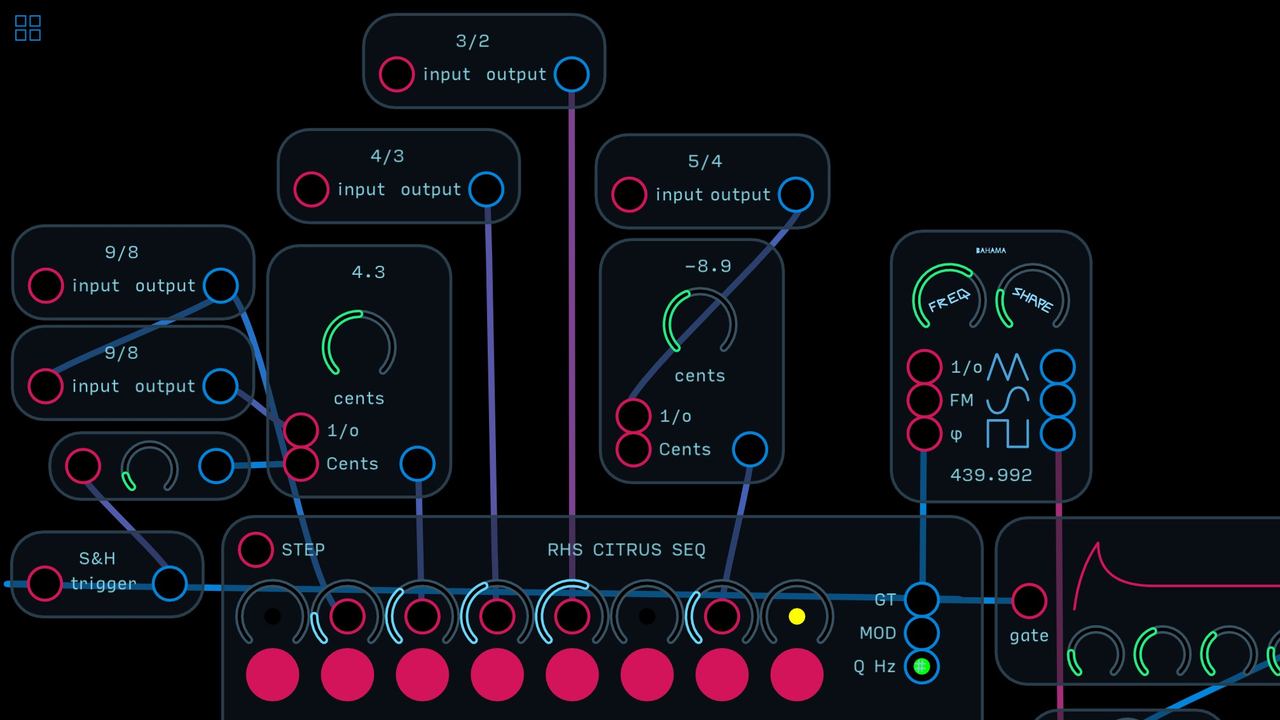
I managed to get started on adapting the Audulus scale quantizer so that each step can be individually adjusted. The first step was to build a little module to enable pitch adjustments within a range of 50 cents up or down. With that in place alongside the little ratio modules that I mentioned in a previous post, it’s already possible to easily set up non-tempered (partially structured) pitch sequences on the fly by attaching them directly to the sequencer pitch knobs. I like to think of it as a set of resistors that can be plugged in as a form of micro-preset, a little like on the old Buchla Music Easels.

Building the ratios and cent adjustments into the scale quantizer means that the alternative scales could also be used in contexts without a sequencer – when using a keyboard for example – and would also collect all the bits instead of having them loosely flying around. That said, there’s something that appeals to me in the clarity and flexiblity of having the ratios and adjustments clearly displayed and easily reconfigurable.

From another angle there were two interesting posts in the Audulus forum this morning covering similar ground: Jimbo’s Microtonal scale modulater and STSchoen’s impressive Audulus recreation of the note quantizer from the very interesting collaborative open source ornament & crime module. Here’s Todd Barton’s introduction to it.

Modular Diary – 037

I’ve been trying to get my head around the inner workings of the Audulus scale quantizer to see if there’s a way to incorporate a knob for each step so as to enable microtonal deviations, but have been finding it difficult to decipher completely. I’m thinking that it might be best to split the quantizer and microtonal adjustments into separate modules. The quantizer can stand as it is1 and feed the quantized values of the chosen steps on to the next module to be bent one way or the other.

In the mean-time I’ve put yesterday’s patch up on the forum.


  1. That also makes it possibile to choose between the quantizer with buttons or the version with knobs (which can in turn be automated by external sources). ↩

Modular Diary – 038

I managed to complete my adaption of the Audulus scale quantizer into a scale bender. Input values within each equally tempered semitone can be shifted up or down by up to 50 cents. It’s no longer a quantizer so if the cent setting should deviate from equal temperament then it’s necessary to place a quantizer in front of it. Without a quantizer (or equally tempered keyboard) the input values are simply offset by the cents setting – i.e a glide within the range of a particular semitone will also glide. That could perhaps be put to some fun uses.

In the demo patch I’ve uploaded to the Audulus forum one can shift between an automated and a manual quantizer preceding the scale bender.

Modular – Diary 039

Looking at new experimental modules it’s amazing how often Don Buchla’s name comes up as the source of inspiration. His Source of Uncertainty as source for the Turing Machine, the Wiard Woggle Bug, the Make Noise Wogglebug, an Audulus Wuzzlebuzz, and the Erica Synths Wogglebug, for example. There’s also his dual oscillator Complex Waveform Generator and outside in approach to interface design that has found resonance in recent years.

This year marks the 50th anniversary of the Morton Subotnick’s seminal Silver Apples of the Moon, a piece which he describes as “a pretty complex piece for my first one and I worked six days a week minimum, 10 to 12 hours a day for 13 months making that.” It was created using the Buchla 100, the instrument Subotnick comissioned Buchla to create for the San Francisco Tape center in 1963.

It’s a year ago and a day, that Don Buchla passed away.

Modular Diary – 040

Two little diversions that sprang out of playing around with my Audulus Scale Bender:

The first patch uses the bender without a quantizer in front of it, with an LFO sweeping across the range of an octave. (There’s also a range control that can be used to centre in around a particular section of the octave, should one wish.) The bender glides up and down following the LFO, but on approaching the next tone falls back and retriggers from the previous semitone. There’s a quantizer placed after the scale bender to help visualise what’s going on.

I also discovered something I hadn’t thought of. Sweeping through a pitch range without all the steps of the quantizer activated creates a rhythmic pattern – and if the pitch range doesn’t match the number of notes exactly that can lead to interesting rhythmical unevenness. Different waveforms can also be fun as a rhythmic/melodic source. The patch includes the phase and frequency modulated waveforms I was experimenting with a week ago, and I can imagine some Rungler chaos being interesting too.

Modular Diary – 041

I calibrated the knobs of my Audulus Scale Bender to have a range of -50 to +50 so that one can easily type in precise cent values manually. I’ve now added external 1/o inputs so that the bending can be controlled from external sources.

To test that out I put together a quick Detuner with three LFOs running at slightly different speeds and ranges. It still needs some work, but demonstrates the basic idea.

Modular Diary – 042

A little more on tuning systems: On the Audulus front STS has been doing some fine work on his o_C Scale Quantizer, and Jimbo refining his Microtonal Scale Modulater. I also updated my Detuner with some internal fixes and a reset input that takes all the LFOs back to their starting point.

I don’t have any of the modular gear needed to make use of it, but I found it interesting to see the multitude of ways for editing microtonal scales (cents, ratios, and fractions, as well as Hz values) that Spektro Audio have added to the latest version of their C.V. Toolkit.

Taking a look through my tuning bookmarks I also came across Todd Mudd’s delightful and thorough Just Intonation Toolkit. It’s great to compare how the different tuning systems feel.

And finally, some of the microtonal scales Aphex Twin created for the Korg Monologue.

Modular Diary – 043

This year marks the 50th anniversary of Morton Subotnick’s Silver Apples of the Moon, and looking at one of the short videos included in FactMag’s interview with Subotnick I was struck by his comment that one of the most difficult aspects for him to determine at the time was how long things should go on for. Listening to the piece with that in mind casts a particular light on its episodic nature and the pacing and duration of those ‘scenes’.

Something else that struck me was his anecdote about how loudly he played the music in his studio while working on it. I remember a history of music class back in my early days at university where I suggested listening to Silver Apples (which didn’t particularly grab me at the time) and Varèse’s Déserts at low volume. How wrong I was! I’d recently revisited Silver Apples, listening to it on headphones, and appreciating it much more from my present perspective, but gave it another shot blasting it out loud though my Genelecs. Makes sense.

Modular Diary – 044

A few weeks ago, while taking a look at the ARP Odyssey, I came across the Bright Sparks documentary. I finally got around to purchasing it and have been working my way through the chapters bit by bit. The picture above is shown in the Buchla section, and I haven’t since been able to get its playfulness and charm out of my head.

A quick image search led me to Todd Barton’s website, where it turns out he has recently put together a series of video tutorials based on Allen Strange’s 1974 user manual for the Buchla Music Easel, from which the picture is taken.1 A synthesizer manual like no other! And a look at the Buchla website, where I’ve also noticed the weasel lounging about, led me to a PDF of the 2013 2nd Edition of that manual.


  1. The same Allen Strange that wrote the extensive Electronic Music Systems, Techniques, And Controls, available at Archive.org. ↩

Modular Diary – 045

I’ve now added an extra set of external inputs to my Audulus Scale Bender so that scales can easily be constructed using a few additional micro-modules. With three or four of the ratio micro-modules, for example, one already has a number of possibilities at hand, and they can also be stacked on top of each other – i.e. the result of one ratio can provide the base for the next. One can also provide a specific (c.v.) base value for a scale (or ratio) – if none is provided the micro-modules default to A = 440 Hz.

Looking at the video for the latest C.V. Toolkit update I was inspired to also include a micro-module for fraction based intervals. As a start I’ve only included one for the octave divided into seven equal parts, but that could easily be adapted for other fractions.

I’ve also included a quick demo with a Pythagorean scale as an example and, with Mozambican Timbila music in mind, one with the octave divided into seven equal parts.

Modular Diary – 046

Now that I have the basics of my Scale Bender in place it’s been time to take a closer look at some of the other modules posted in the Audulus forum. STS has done some fine work on a Turing Machine, Copier Maschine, and Variable Note Quantizer. As is often the case I found it useful to take a step back and look at some YouTube videos of the Eurorack module that STS’s Copier and Quantizer modules are based on.

The ornament & crime module is quite extensive in its set of features and STS has chosen to break down some of its functionality into smaller modules. I tend to think of modular synthesis as an approach miles away from scrolling though banks of inscrutable presets – as an approach based on understanding a basic set of principles and building from there (in the moment), but it seems as if the different worlds are slowly merging.1 STS’s Copier Maschine module is based on the Copier Maschine mode of the o_C module, as explained in this video which also covers masking notes with the o_C scale quantizer.

Having watched that, I went back to STS’s demo patch and had a lot of fun playing around with it, making some additions and adjustments of my own. Once the copier shifts get going one can listen to the ever-changing texture (essentially a close 4-part canon) for hours, but I always enjoy the first static moments as it gets started.


  1. There are now even touchscreen Eurorack modules. ↩

Modular Diary – 047

While taking a look at the Spektro Audio site, the makers of C.V. Toolkit, I noticed that they are also the creators of the PatchBook markup language for modular synth patches. Cristian Vogel, for example, used it to share his patch for Modular Day Barcelona on Twitter a few weeks ago.

PatchBook is a (human readable) plain text format that applications can parse to build a graphic representation of a modular patch. In that way it’s a little like the text editor (iA Writer) that I’m using to write this post. As I’ve explained in some previous posts, it’s an approach I’m enthusiastic about.

It occurred to me that the relation of Audulus to something like Max or PD might also be thought of as somewhat analogous to the relation of a writing application such as iA Writer and something like Pages or Word. One can do a lot more in the latter, and they certainly have their use and place, but I definitely get more done within the focussed restraints of the former.