rss

Modular Diary – 009

I’ve been thinking of how YouTube seems to have turned out as the channel for sharing modular stuff. Of course one important aspect (in the absence of being able to save patches) is being able to see the modules and how they’re patched together. Another is the many demonstrations of modular gear – almost small performances in themselves.1

Warp records recently published a wonderful (long) interview between Richard D. James (Aphex Twin) and Tatsuya Takahashi, one of the Korg engineers he worked with on the Korg Monologue. Amongst the many topics they cover is Richard’s fascination with synth demos:

I’m a secret nerd-fan of synth demos, mainly vintage ’80s ones currently! Some amazing music has been made as equipment demos, unsung heroes. I collect synth demos. Well, ones that I like. It’s kind of an unclassified music genre…

On can trace that fascination on a gradual scale from his Korg demo to last year’s Cheetah EP – focussed entirely on an obscure 90s synth of the same name.


  1. Mylar Melodies, for example. ↩

Modular Diary – 010

Perhaps the most interesting aspect of the Richard D. James interview is his approach to tunings – thinking back over the Aphex Twin catalogue it becomes clear just how much they are an integral part of his sound(s). I was especially intrigued by his mixing systemised tuning with notes that are empirically chosen. And his thoughts on how sequencer patterns can can evolve when combined with custom tuning set-ups.

I’m still surprised by the extent that the modular world, having largely emancipated itself from keyboard thinking, seems to largely stick to equal temperament with it’s quantizers. Perhaps there’s been a greater focus on timbre, and the there’s the challenge of keeping voltage controlled oscillators in tune over a wide range, but as is clear with Aphex Twin, timbre and tuning are related.

Individual oscillators can of course be tuned exactly as one wants to. I experimented a little with the Moog Model 15 App, with the tooltip coming in handy when trying to nail pure intervals between the two oscillators. It’s also possible to set up equal distance scales (with divisions other than twelve) by attenuating the keyboard/input voltage.1 Arpeggiator pitches are quantized but it is possibile to use the fluid velocity output to control the pitch of the oscillators – the only catch is that one can’t zoom in on the arpeggiator controls as one can with the modules.


  1. Moog includes a 15 note EDO microtonal organ preset that does this. ↩

Modular Diary – 011

The arpeggiator of the Model 15 App is a step into getting an idea of how early analogue sequencers were set up: A voltage control knob for each step of the pattern. For pitch those voltages would typically be passed through a quantizer before being routed to an oscillator, but they might just as well be used to control velocity or filter cutoff, for example, perhaps with a parallel row for controlling gate times.1 It’s quite a different world from the piano roll visualizations one is accustomed to with DAWs, and encourages a different way of thinking – a different approach to creating and using sequences.

When I first started using Audulus I was somewhat puzzled by some of the sequencer modules included with it. I’ve since come to better understand (and appreciate) the old analogue models on which they are based. The great thing with Audulus is that all knobs can be linked to any other form of control – that means that the knob for each sequence step can potentially be controlled by an LFO or Random generator, to pick two examples. The sequencer can not only send out a set of control signals, but also be modulated itself.


  1. The Korg SQ-10 is a good example. Here’s a video with the SQ-10 controlling the MS-20 filters. ↩

Modular Diary – 012

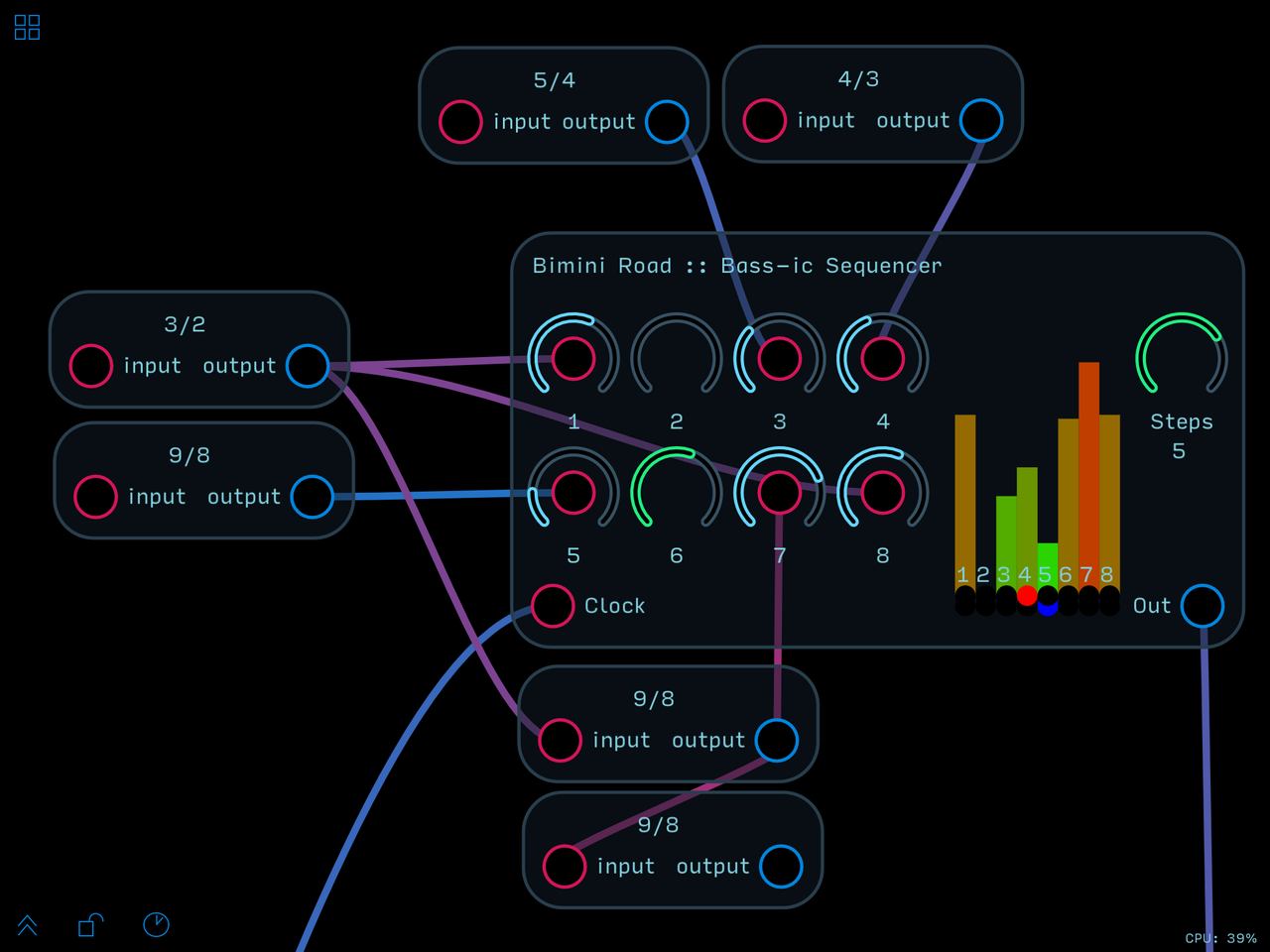
With Audulus, as with most modular systems, the sequencer ‘control voltages’ are typically quantized before being passed on to an oscillator. I was keen to try out tunings with pure ratios and at first thought of piecing together a just intonation quantizer. However, since the sequencer knobs are fluid, it occurred to me that I could simply put together a small collection of ratio modules and connect them freely to the knobs. In this way some steps might be purely tuned while others could be set empirically.

The modules have an inbuilt reference pitch of 440Hz – that means that the 3:2 ratio will produce a pitch a perfect fifth above 440Hz. If the input is connected to a keyboard (or other) source the ratio will take that input as it’s starting point. The modules can be strung together so that the output of the 3:2 module can be connected to the input of a 9:8 module for example – producing a just second above the pure fifth.

Here’s an Audulus patch (very much a tryout, with the inclusion of all kinds of other bits and pieces I was experimenting with) demonstrating the approach.

Audulus Basic Sequencer Tryout

Modular Diary – 013

A quick look at a few hardware sequencers that I’ve come across during the last few months:

Starting off with Mylar Melodies’ wonderful tour of the Intellijel Metropolis. (And Robert Syrett’s Audulus recreation of it.)

A step back to classic analogue sequencing (in a modern form) with the Doepfer MAQ16/3.

The Korg SQ-10, another classic given modern form as the Korg SQ-1 (here coupled with the Make Noise O-Coast).

Aphex Twin’s Cirklon.

And a step out of linear time with the Make Noise René.

Modular Diary – 014

One of the recent guests on Darwin Grosse’s Art + Music + Technology podcast was E-Mu Systems Dave Rossum. Along with tracing the beginnings of the E-Mu Modular he also mentions the modular sequencer developed for the system. The idea of a sequencer broken into smaller component modules intrigued me, but I haven’t been able to find much information on it on the web.

What I did find was a video of Benge demonstrating it.

Benge also provides a grand tour of basic sequencer techniques demonstrated on Moog, ARP, Roland, Serge, and Buchla modular systems, as well as a little diversion with the VCS3.

Following up on Benge’s sequences I came across this thorough demonstration of classic Berlin School sequencing with a Doepfer MAQ16/3 and a Synthesizers.com Q960 (a recreation of the Moog 960).

While Benge uses a quantizer after the 960 Martin Peters tunes his sequencers by ear/hand – and that’s the possibilty that intrigues me. Hand (micro)tunings, and the possibility of setting up special tunings for a sequence without having to account for a complete system as one would be inclined to when thinking in terms of a keyboard.

Modular Diary – 015

It seems to me that a large part of the increase in activity on the Audulus forum during the last half year has been due to recreations of hardware modules/instruments. The hardware models seem to provide a useful grounding – something to kick against in the open space of the software platform. In the absence of owning any hardware syths at the moment I’ve also found the fixity of app recreations – the Moog, Ripplemaker and VCS3 apps that I’ve looked at, a useful counterpart to the openess of instruments/devices created in Audulus. I do keep coming back to Audulus though – it still ends up being the place to get on with some real building after diving into the behaviour of the other apps.

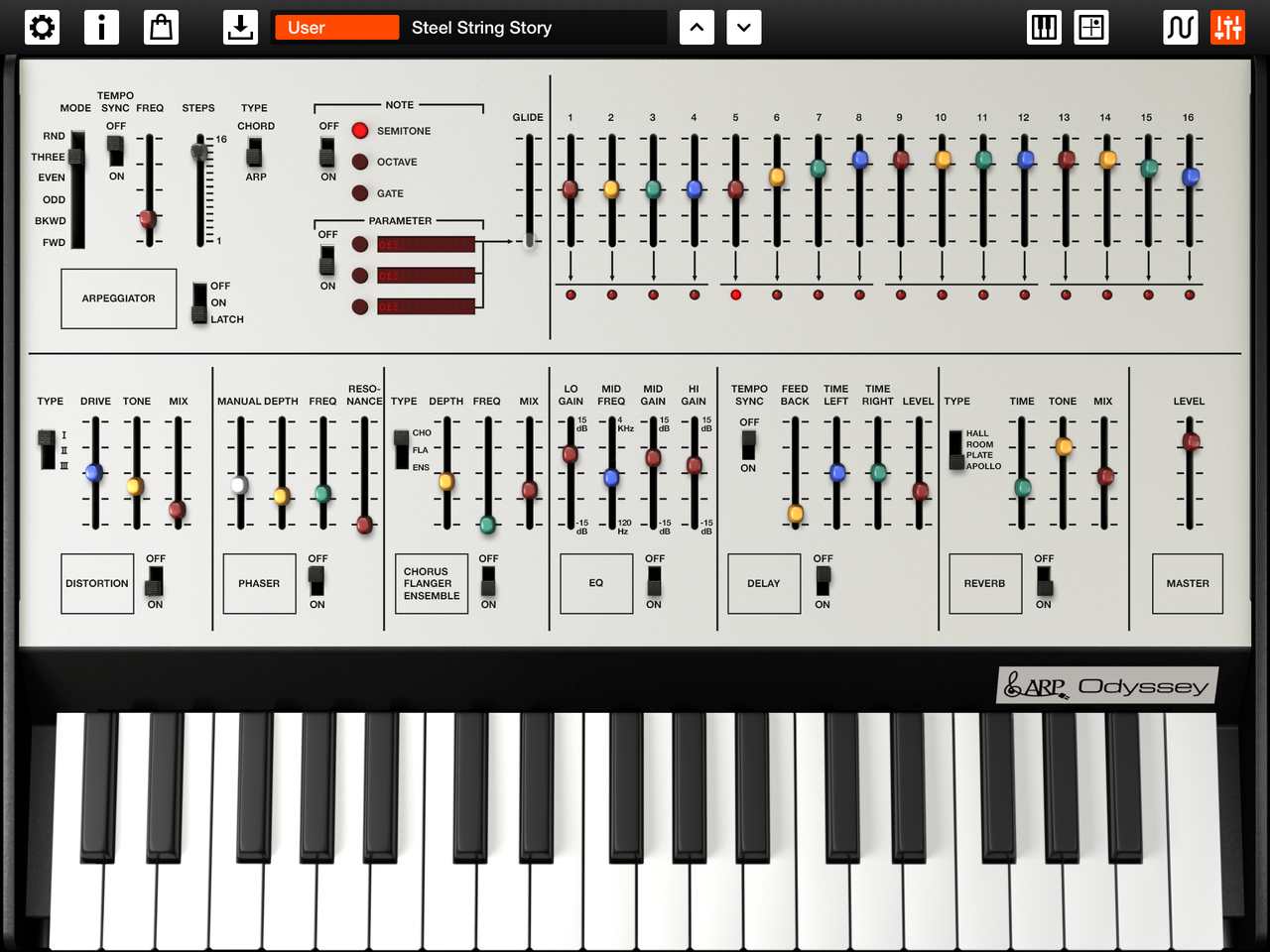
A few weeks ago I had the Korg 2015 version of the ARP Odyssey under my fingers on a visit to a music shop, and now the Korg ODYSSEi also has it’s place on my iPad. While not exactly a modular synthesizer it has a wealth of routing options that make it extremely flexible, while at the same time practical to use as an instrument. GForce have created their own software version of it – the Oddity – and also provide a wonderful introduction to the original as part of their synth archive. As they mention in the video this can be a bit of an in-your-face punk instrument. The opposite of the distant spaciness of the (i)VCS3.

The iPad ODDYSEi sounds great, and especially with the white Rev. 1 face is a visual pleasure as well. The fader interface design1 (there are no knobs on this synth) seems well suited to an iPad touch-screen. I was delighted to find that the analogue tuning has been modelled as well. One can shift between pure equal temperament and the analogue version if it and clearly hear the differences. Richard D. James talks about layering similar differences between equal temperament and the analogue tuning of the Roland SH101 in his interview with Tatsuya Takahashi.


  1. With handy tooltips too. ↩

Modular Diary – 016

The ARP Odyssey marks is an interesting point in the development of sythesizers with some of the flexibility of the modular systems it grew out of and the fixity of a portable performance instrument that became the norm. I’ve been thinking about the development of synthesizers over the years – the gradual change from modular systems that lent themselves to ever-evolving textures to banks of presets and large libraries of relatively short sounds. The Art + Music + Technology episode with E-Mu’s Dave Rossum provides a good example of this arc – and the spiral back to the beginning that we’ve now reached.

Benge’s 20 Systems presents 20 pieces of music created with 20 different synthesizers, one from each year between 1968 and 1988. Starting with the Moog Modular 1968, moving through ARP, Serge, Roland, Oberheim, and Yamaha in the 70s, and ending with the Fairlight and Synclavier, amongst others, in the 80s. I was thrilled to receive the CD as a gift when it first came out nearly a decade ago, feeling that it nicely mirrored the first 20 years of my own life. It too provides a good trace – a journey in sound of the arc from evolving textures to precise presets.1


  1. See also Junkie XL’s historical overviews of his classic synth collection. ↩

Modular Diary – 017

The interesting thing with modular systems is that things can be fed back into themselves. The O-Coast Krell that got me started with all of this is a good example. The generative aspect puts one in a very different position from the prog rock ‘keyboard wizard’ of the 70s. The person ‘playing’ the modular is potentially both listener and performer.1

Oscillators and filters can be feedback loops within themselves – which can then be connected together to form larger systems in which everything feeds back into everything else. Cicuits such as Rob Hordijk’s Rungler, Benjolin and Blippoo Box embrace the chaotic behaviour that can arise, with the player more in the role of steering the direction of the sound than using it as a form of ‘expression’.

Nicky Case recently presented a wonderful talk at The Long Now Foundation: Seeing Whole Systems. He visualises differences between linear cause and effect thinking, and complex systems in which everything influences everything else, covering examples from nature and social constellations to health and economics. He suggests some tools (and has also written games and apps) that might help us learn how to steer and play the chaos.

And that’s exactly what a lot of modular people are doing.


  1. See Walker Farrell’s thoughts on his own back and forth bewteen generative systems and improvisational input in the Cycling 74 interview with Zeos Greene. ↩

Modular Diary – 018

In the liner notes to 20 Sytems Benge explains his initial aim of ‘letting the instruments speak for themselves’:

The original idea for 20 systems was to set these machines running and hear what they could do with no personal input at all. But none of these machines are capable of working on their own: a certain amount of input has been necessary to create something musical with them.

The balance between setting up generative situations and interacting with them.

Each track on 20 Systems was intended as a presentation of the ‘pure sound of the individual instrument’. Benge has since embarked on a series of albums each focussed
on a single synthesizer system. I’ve been listening to two of them lately, at first enjoying the clean abstraction of Abstraxa, created using the Buchla Electronic Music Box, and now slowly coming to consider the two long Serge tracks of Forms 6 – Works on Paper to be something of a masterpiece.

Modular Diary – 019

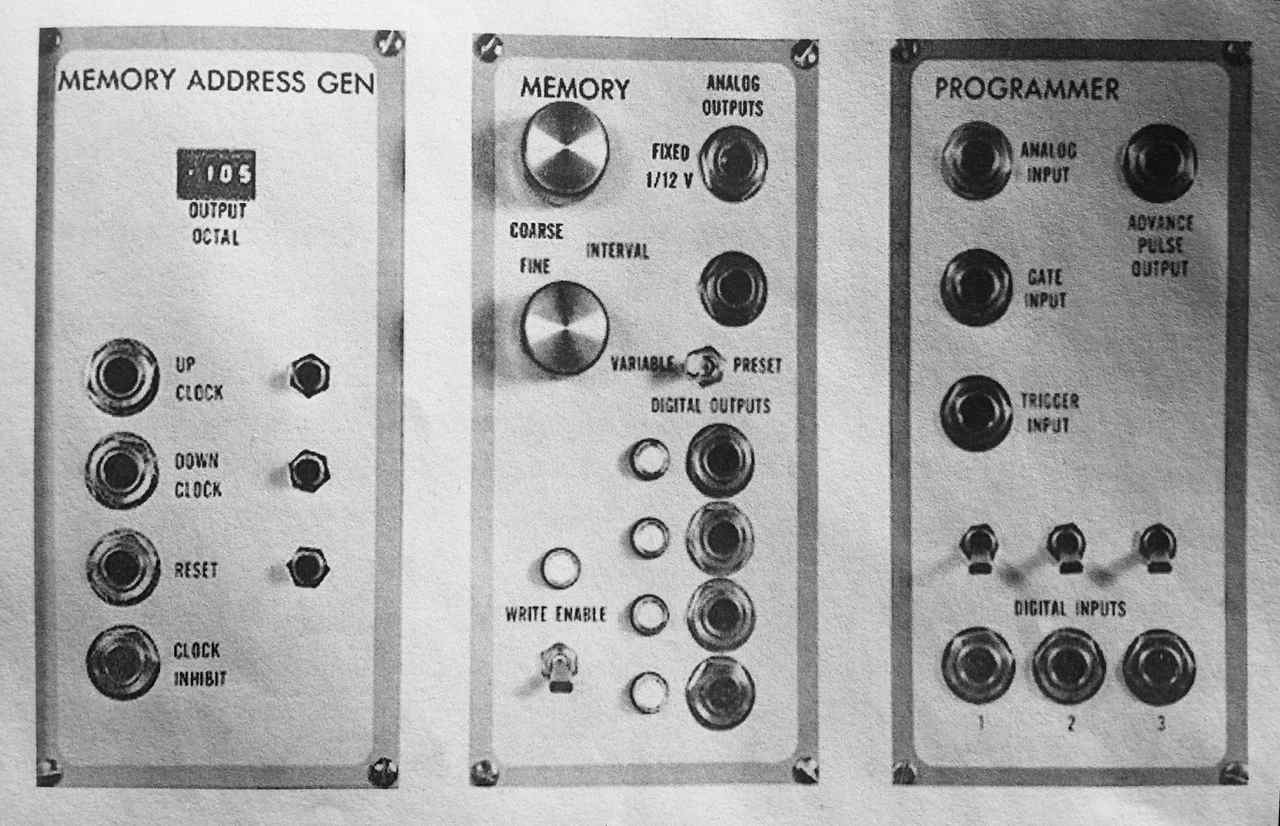
As I mentioned a few days ago I was intrigued to find out about the the EM-u modular sequencer on Darwin Grosse’s Art + Music + Technology podcast, but had a hard time finding more information on it. Digging through Benge’s blog I discovered that he too had difficulties gathering information on the workings of this device. I also came across the picture above, some more videos, and an entry with a detailed explanation of setting up a 32 step sequence on it.

Modular Diary – 020

I was watching a video of Lars Lundehave Hansen’s Lunar Eclipse and got to thinking of mechanical sequencers (to take a step even further back than the analogue ones). I seem to remember seeing a post about someone constructing an electro-mechanical sequencer with control voltages so that it could be used in a modular set-up. I unfortunately haven’t been able to find my way back to that post, but remember it as being based on a circular switch similar to the one found on the 1959 Wurlitzer Side Man. It also go me thinking of the Polyphons that inspired the sound-sculpture that Ida Raselli presented in a recent Frankenstein’s Lab. Finnish sound artist Martin Bircher used a similiar Symphonion as the basis for a hand-cranked MIDI sequencer.

In a way it’s surprising that circular forms aren’t more common in sequencer design. There’s the Buchla 250e (that Benge used in his tour of sequencing modular systems) or iOS apps like Patterning or dot Melody. I can’t think of much else.

Modular Diary – 021

I‘ve been taking a look at putting together a quantizer for custom tunings in Audulus – there’s been a little activity on that front in the forum. I have in mind something that builds on the small ratio modules that I was using to tune a sequencer in a previous post. Something very flexible that can be changed on the fly with the possibility of additional ‘hand-tuned’ deviations from the basic ratios. A kind of hybrid between systematic and empirical tuning.

Since it’s taking me a little time to figure it all out here’s a little experiment with changing the tuning on the ARP ODYSSEi from Equal to Analog while running a simple sequence. The deviations are subtle but nevertheless quite noticeable (often a little flat in relation to equal temperament) – at some point it could be interesting to measure them precisely and put together a little list that could be used in other contexts.1

Here’s the unadorned sequence – two cycles in equal temperament followed by two with the analogue tuning:

ARP Equal Analogue

And a longer jam trying out the analogue tuning at different transpositions as well as playing with the length of the sequence.

ARP ODYSSEi Analogue Sequence

  1. See, again the Richard D. James interview with Tatsuja Takahashi. ↩

Modular Diary – 022

Here’s a quick comparison of the differences between the Equal and Analog tunings on the ARP ODDYSEi – and how they compare to strict equal temperament. I’ve only measured one octave up from A = 440 Hz and am curious to measure how the tuning behaves in the other octaves as well. Interestingly I had to set the master tuning to 437.6 Hz on the ARP in order to get a measurement of 440 in Audulus. And the analyzer in MC Studio is showing pitches roughly 4 Hz below the equal measurements taken with Audulus. I’m not sure what’s going on there. Something to look into.

Equal Temp. ARP Equal ARP Analog
A  440 440 441
A# 466 466 468
B 494 494 496
C 523 524 526
D# 554 555 557
D 587 588 591
D# 622 624 626
E 659 661 664
F 698 700 704
F# 740 743 746
G 784 787 792
G# 831 835 840
A 880 884 890

The next step is to calculate the deviations in cents.

Modular Diary – 023

Here are yesterday’s measurements of the ARP ODDYSEi Equal and Analog tunings with the deviations from equal temperament indicated in cents.

ARP Equal (cents) 12-T.E.T (cents) ARP Analog
A 440 - 440 4 441
A# 466 - 466 7 468
B 494 - 494 7 496
C 524 2 523 9 526
C# 555 2 554 8 557
D 588 2 587 11 591
D# 624 5 622 10 626
E 661 5 659 12 664
F 700 4 698 14 704
F# 743 7 740 14 746
G 787 7 784 17 792
G# 835 9 830 19 840
A 884 8 880 20 890

Modular Diary – 024

Scratch the measurements from the last two days. I’ve been puzzled by the frequency readings I’ve gotten in Audulus – made using the Mic (External Input) 1 and ZeroCross nodes. (Calculating the deviations in cents was also done in with a little patch using the Audulus Hz2o (Hz to octave) module.)

I found a little tuner app that displays deviations in cents nice and clearly, and tried making some measurements with it directly via my iPhone’s microphone. I could set the ODDYSEi master tuning back to 440 and have the frequency register as a perfectly tuned A4 on the app – which is what one whould expect. The ODDYSEi Equal tuning matches equal temperament perfectly according to the tuner – which makes sense, also aurally! It turns out that Analogue tuning is calibrated to a near perfect A3 (220Hz) and gradually gets sharper as one moves up over the next 3 octaves. Inversely, moving down gradually gets flatter.

ARP ODDYSEi Analog tuning deviations in cents over 6 octaves:

A1 A2 A3 A4 A5 A6
A -39 -30 -1.2 4.8 10.6 16.5
A# -32 -7 -0.7 5.2 11.4 17.1
B -29 -12 0.2 5.6 12 17.6
C -15 22 0.5 6.2 12.4 18.2
C# -47 -19 0.9 6.9 12.9 18.8
D -44 -14 1.2 7.2 13.3 19.3
D# -19 -6 1.7 7.9 13.8 19.1
E -40 -5 2.4 8.4 14.3 20.4
F -30 -4 2.8 8.8 14.9 20.8
F# -10 -3 3 9.2 15.4 21.3
G -7 -2 3.8 9.8 15.8 21.5
G# -17 -2 4.2 10.2 16.1 22.1

(The measurements for the lower 2 octaves fluctuated a lot and were therefore more tricky to notate precisely.)


  1. Feeding the ARP ODDYSEi in via AudioBus. ↩

Modular Diary – 025

I went back and listened to the tryouts of the self-made TTSH that Jesper Pedersen posted on SoundCloud a while ago.1 (The Two Thousand Six Hundred is an unusual DIY clone of the ARP 2600.)

It’s interesting to think that while preceeding it by a year, the modular 2600’s production run is more or less parallel to that of the Oddysey. It’s a very particular sound those ARP instruments have!

In contrast to the punch of the first sequencer tryout that Jesper posted there’s also a warm drone and a more mellow sequence with some nice intonation and modulation details that appear as it progresses.


  1. “I began building hardware to take a little pause from software” he comments in the comments. ↩

Modular Diary – 026

I particularly enjoyed the Cuckoo overview of FM principles that I came across in the Audulus forum thread on AM/FM/PM modulation.

I’ve since been wanting to take a closer look at the difference between linear and exponential frequency modulation and came across this video (also featuring an old ARP Oddysey Mk I) by Synthesizer Keith.

There’s a follow-up Reddit thread also clarifying that it’s linear modulation at play in the Yamaha DX style FM – the phase type of frequency modulation that Cuckoo refers to in his video – as well as a similar thread at KVR.

Keith refers to the Yamaha style linear FM as being “more musical” in his video, and there’s a Reddit thread, leading to a Muff Wiggler thread, on that question as well.

I found it interesting to look through the Wikipedia entry on Frequency modulation synthesis. I always associate FM with the 80s (the DX7!) but as the article points out Yamaha was already developing (and patenting) it (after famously licensing it from John Chowning1 ) in the mid 70s. It was only in 1980 that they’d developed the technology to a degree stable enough to release it commercially in the form of the curious Yamaha GS-1.

All of which was preceeded by Buchla with his own developments and implementations in the mid-60s.


  1. Chowning patented the digital implementation of FM in 1975. ↩

Modular Diary – 027

A week ago I wrote about (circular) mechanical sequencers and a lost post that I’d seen on a (re)construction of one for modular use. I still haven’t found the post, but in my searches for material on linear FM yesterday did come across this circular cardboard sequencer. There’s a fun video in addition the post on how to build it.

And that reminded me of some funny little bits tacked onto the end of some episodes of Reply All. Here’s one, and here’s another.