↬ Twenty-six – 06: Re-entry
Hi, I’m Rudiger Meyer, and this is (what was once) my monthly newsletter covering what I’ve been up to and what’s been catching my attention.
Two and a half years have passed since my last newsletter, and I’ve enjoyed the pause, finding myself somewhat unmotivated to post, both on my site and social media. That lost enthusiasm is perhaps not so strange, possibly part of a greater malaise connected to our current world/media landscape. With surveillance, AI eating up all our content, and companies even coming after bloggers for including ‘copyrighted’ pictures on their personal sites, finding ways to extract what they can, the old ‘web is for everyone’ is going through difficult times.
And yet, the slow decline of the social media giants has made place for a re-evaluation of ‘how it started’. For myself, letting go of the ‘timeline’ frame of mind. That a picture posted doesn’t have to be from the ‘now’, could be taken at another time. I noticed some personal sites picking up on the idea of a garden, rather than always structuring with the standard reverse chronological timeline. A place where things can be tended, given time to unfold.
I did a little (mostly behind the scenes) maintenance of my own site earlier this year. Updated the wavesurfer.js that I use to play (and display) audio on some of my work pages, to the latest version. I also used some of its recent features to recreate a little thing around a Rilke poem that I’d built using the Soundcloud API many years ago. That API had been discontinued and so it was an interesting little exercise to remake it using wavesurfer. I’ve questioned whether revisiting the old stuff is worth it, whether it’s perhaps best to just keep ‘moving on’, perhaps even drop all that’s been accumulated over the years and move on to a next chapter ‘lean and clean’, but came to the conclusion that there is a value to it, a desire to respect to those efforts, both the successes and the failures. That the maintenance is worth it. That it contains seeds of the future.
One of the projects I’ve been revisiting, updating with the thought in mind that it’s ten years since his death, is my Vagn Steen Lydfabet. A little update/modernisation with what’s available in Ableton Live now, nearly twenty years later. (I recently bumped into Linda Hintz at a café, and that also got me thinking more deeply about letterforms again.) Looking back at the beginnings of that project, and the programming computer cards that Vagn used for random selections in some of his poems from the sixties, also got me thinking of those techniques in terms of where we’ve landed with modern LLMs, and how different our relation to that kind of language manipulation is now.
Robin Sloan has a little Winter Garden series of newsletters (again a garden, slightly set apart) on the subject of AI. With a look back to his own first experiments with it 10 years ago. There the connection to Vagn’s first experiments some 50 years before can still be made, before the jump to our current AI maelstrom. But that simple random stringing of a selection of words together can still be delightful, perhaps precisely when it remains a small selection and not the boundless vacuuming up of all mankind. See: ky.fyi Design Is.
I recently attended a Sophie Calle exhibition and enjoyed her ‘Because’ series of photographs, presented behind little curtains of text. Where you first read the text and then lift away the fabric to reveal the photograph. Perhaps a little like what Craig Mod did a few years ago with one of his photography projects, where you first read the text and then got to see the photograph. I did something similar with the overview of my Lockdown Photos. It got me thinking of the whole web alt-text thing again, and how I’ve continued to enjoy it. All the photo descriptions on my site that you only get to see if you click on them. Hidden in (almost) plain sight.
Again, the idea of something public, but not in your face. Slightly protected gardens. Or like Luis Mendo’s MundoMendo, where there is something that’s public, but the larger part is behind the scenes in a little courtyard for subscribers. Craig Mod has something similar with his Special Projects.
* * *
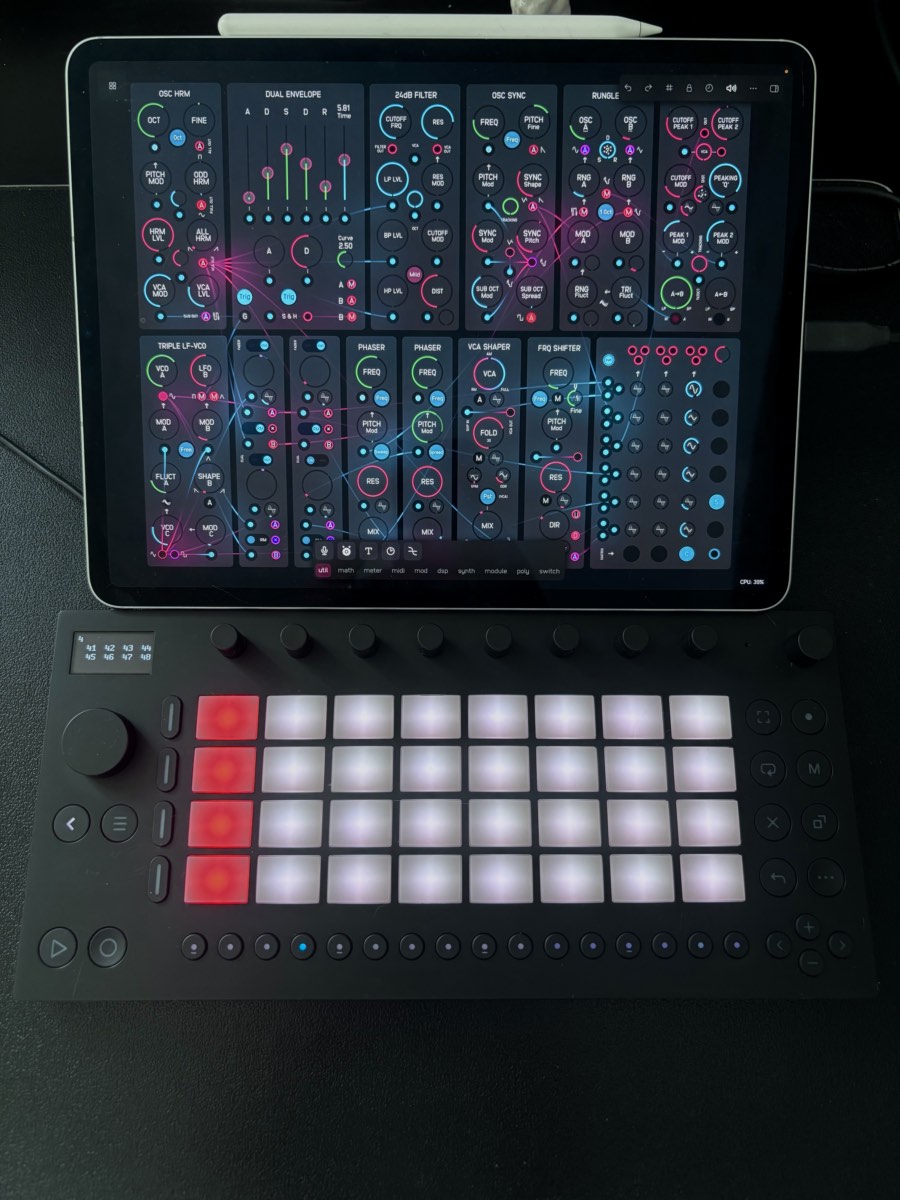
On another track, and moving in the opposite direction, I spent some time making a place on my site for all of the Audulus modules I’ve created over the years. A public place for them outside of the somewhat insular world of the Audulus Discord. Rescued from the obscurity of a thousand Discord threads!
That’s been an interesting consolidation of nearly a decade of explorations in modular synthesis, a large part of which has been my reconstruction of Rob Hordijk’s modular system. Giving the modules a final polish, and getting the documentation for each up to date and in place.
I also started exploring using an external controller to ‘play’ all of that stuff, ending up with installing RNBO on my Ableton Move. That’s been working really well. Great that Ableton kept an internal door open to make that kind of thing possible.
* * *
Someone asked me recently if there was a piece of music that I considered to be ‘perfect’, and I found myself struggling to think of an example. There are many pieces of music that have been highly meaningful to me, but I have difficulty in labelling any of them ‘perfect’. It’s an aspect that doesn’t seem important.
I did think of an album though: King Crimson’s Discipline. I listened to it quite a lot around 30 years ago and recently went down a bit of a rabbit hole of (re)discovering their music. Discipline is the only album of theirs that I knew previously, and I still find it their best. The first of a trilogy, and, for me, undoubtedly their masterpiece. Also fun to see some of the live concerts from that time. Adrian Belew is a guitarist that I know all the way back from my teenage years through his work with Talking Heads, and especially from another favourite form that time: Laurie Anderson’s Mr Heartbreak.
Some students in Germany will be playing Two Hockets, a very early piece of mine, and that got me thinking of Discipline, the final track on the Discipline album. A similar kind of thing, although I only got to know it after writing the hockets. The level of achievement with the Crimson track is on a very different level though.
Perhaps not a million miles from the King Crimson, but someone else that also achieves a kind of perfection, again with a high dose of discipline, is Nik Bärtsch. I came across a very nice interview with him recently, and got to listening through some of his albums again, after having gotten into his world via a fine documentary series last year. It’s good music to get you centred, should you find the need for that in the midst of life’s chaos. The interview covers a lot of aspects concerning the classical avant-garde/new music and rock/jazz/world-music developments, and our understanding of how all of these things have influenced each other and how we relate to them from our present vantage points, and that had me nodding along given my own path and how it’s been shaped by many of them.
* * *
David Hockney died at the age of 88, almost 89. One of my favourite artists. His 1988 book of interviews with Paul Joyce (Hockney on Photography) deconstructing how photography and perspective have shaped our sense of space, of making us observers of the world rather than communicating our experience of being in it, was hugely important to me in my late teens and early twenties. Still is.
It’s also Morton Feldman’s 100th year. A bunch of new recordings have appeared, and it’s been interesting to take a listen to the interpretations and various approaches to recording these works. I still find the old Hat Hut recordings that were my introduction to many of his late long form works, to be the best though.
* * *
And with all the goings-on in and around Iran, an episode of the New York Times, The Daily podcast opened up an interesting new perspective on the circumstances surrounding Xenakis’ Persephassa and Persepolis, works that I’d written about in my newsletter three years ago. (John Cage’s First Construction in Metal and Varèse’s Ionisation had also been performed at the same festival.)
Michael Barbaro: So the American Shah finally begins to win over the Americans.
Scott Anderson: That’s right. And on Khomeini’s part, he sees the Americans now as the instrument of his exile. And so as anti-American and anti-West as he was before, it’s now exponentially more so. But the Shah seems to have learned virtually nothing from Khomeini’s uprising of a few years earlier. He doesn’t seem to get that his close relationship with the West is any kind of problem. And, in fact, he does something that just cements how totally enamored he is to the West, even at the expense of regular Iranian people. And that happens in October of 1971.
The Shah wanted to have a grand party to celebrate the 2,500 years of Iranian imperial dynasty at Persepolis, the ancient capital of Persia —
this three-day extravaganza in the desert, where virtually all the guests were foreigners, and virtually all the supplies and everything were foreign. There will be plenty of food, but the only Iranian dish on the menu is caviar, a few hundred pounds of it. All the rest is French. Maxim’s restaurant in Paris closed down for two weeks, and all the waiters of Maxim’s came to be the waiters at this banquet… And so it really got to this kind of inferiority complex, that the West was the best.Michael Barbaro: And I have to imagine all these rural, religious folks watching their leader put on this extravagant, as you said, grotesque banquet on behalf of Western leaders is deeply offensive.
Scott Anderson: Oh, absolutely. Significantly, it was denounced by the exiled Ayatollah Khomeini, who called it the Devil’s Festival and says anyone who attends is participating in the murder of the people of Iran.
That Westernisation had opened up for the emancipation of women in Iran, a freedom that was then brutally eradicated. The Times and Anderson have their own particular telling of the story, but I found it a fascinating perspective the complexity of transformation as well as some context around the performance of works by figures that have been my heroes.
All the best,
↬ Rudiger
